การบูรณาการหลักการทรงงานข้อที่ 2 “ระเบิดจากข้างใน” กับเป้าหมายการพัฒนาจากภายในสำหรับการพัฒนาหลักสูตรเพื่อส่งเสริม ทักษะชีวิต การคิด และความสัมพันธ์ (ทักษะที่ไม่ใช่เทคนิค)
คำสำคัญ:
ทักษะชีวิต, การคิด, ความสัมพันธ์, หลักการทรงงาน, ระเบิดจากข้างในบทคัดย่อ
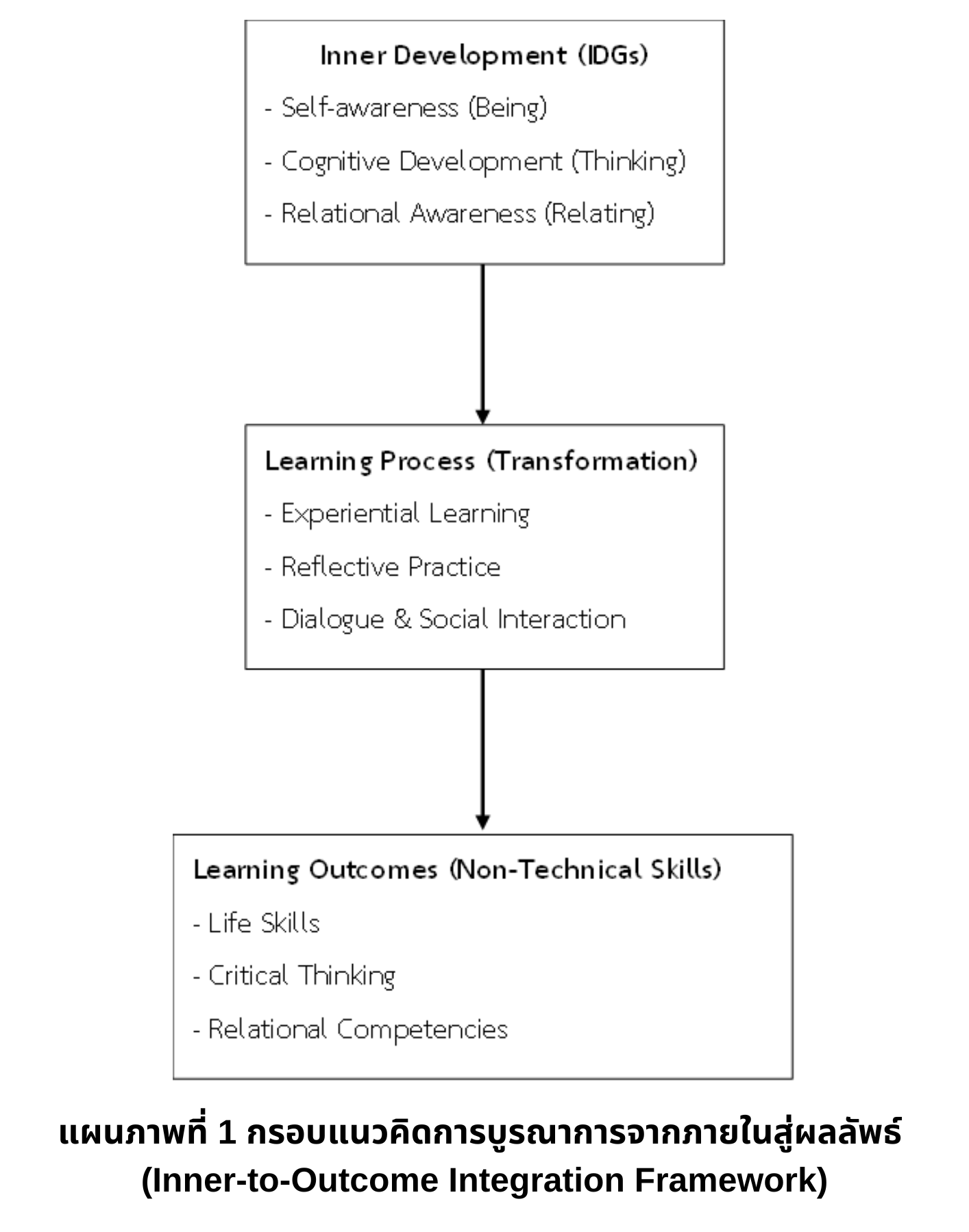
งานวิจัยเชิงคุณภาพนี้มีวัตถุประสงค์เพื่อวิเคราะห์และสังเคราะห์การบูรณาการหลักการทรงงานข้อที่ 2 “ระเบิดจากข้างใน” กับเป้าหมายการพัฒนาจากภายใน เพื่อใช้เป็นกรอบแนวคิดในการพัฒนาหลักสูตรที่มุ่งส่งเสริมทักษะที่ไม่ใช่เทคนิค ได้แก่ ทักษะชีวิต การคิด และความสัมพันธ์ โดยใช้ระเบียบวิธีวิจัยเชิงคุณภาพในลักษณะของการวิเคราะห์เอกสารและการสังเคราะห์เชิงแนวคิด ผลการศึกษาพบว่า หลักการ “ระเบิดจากข้างใน” มีความสอดคล้องกับแนวคิด IDGs ในมิติของการพัฒนาจากภายในของมนุษย์ โดยเน้นการตระหนักรู้ตนเอง การเปลี่ยนแปลงภายใน และการขยายผลสู่การปฏิบัติภายนอกอย่างยั่งยืน การบูรณาการทั้งสองแนวคิดสามารถนำไปสู่การออกแบบหลักสูตรที่เน้นกระบวนการเรียนรู้เชิงประสบการณ์ การสะท้อนคิด และการมีปฏิสัมพันธ์ทางสังคม ซึ่งส่งผลต่อการพัฒนาทักษะชีวิต การคิดอย่างมีวิจารณญาณ และความสามารถในการสร้างความสัมพันธ์อย่างมีคุณภาพ องค์ความรู้ที่ได้จากการศึกษานี้สามารถใช้เป็นแนวทางในการพัฒนาหลักสูตรและการจัดการเรียนรู้ที่ตอบสนองต่อการพัฒนามนุษย์อย่างรอบด้านในศตวรรษที่ 21
เอกสารอ้างอิง
ชัญญานุช โมราศิลป์, & ทักษญา สง่าโยธิน. (2562). แนวทางการน้อมนำหลักการทรงงานของพระบาทสมเด็จพระปรมินทรมหาภูมิพลอดุลยเดช บรมนาถบพิตร ไปใช้ในการปฏิบัติงานขององค์กรธุรกิจ. Humanities, Social Sciences and Arts, 12(1), 710–735.
รัชนี อิ่มอก. (2564). การพัฒนารูปแบบการจัดการเรียนรู้ตามหลักการทรงงานของพระบาทสมเด็จพระเจ้าอยู่หัวรัชกาลที่ 9 เพื่อส่งเสริมความเป็นพลเมืองดีที่ใส่ใจในสังคม. วารสารสังคมศาสตร์และมานุษยวิทยาเชิงพุทธ, 6(12), 204–220.
สำนักงานคณะกรรมการพิเศษเพื่อประสานงานโครงการอันเนื่องมาจากพระราชดำริ (สำนักงาน กปร.). (2559). หลักการทรงงานในพระบาทสมเด็จพระเจ้าอยู่หัว. (พิมพ์ครั้งที่ 11). กรุงเทพฯ : สำนักงาน กปร.
Bonwell, C. C., & Eison, J. A. (1991). Active learning: Creating excitement in the classroom. Washington, DC: George Washington University.
Bronfenbrenner, U. (1979). The ecology of human development: Experiments by nature and design. Harvard University Press.
Endsley, M. R. (1995). Toward a theory of situation awareness in dynamic systems. Human Factors, 37(1), 32–64.
Fletcher, G., Flin, R., McGeorge, P., Glavin, R., Maran, N., & Patey, R. (2003). Anaesthetists’ non-technical skills (ANTS): Evaluation of a behavioural marker system. British Journal of Anaesthesia, 90(5), 580–588. https://doi.org/10.1093/bja/aeg112
Flin, R., O’Connor, P., & Crichton, M. (2008). Safety at the sharp end: A guide to non-technical skills. Ashgate.
Gordon, M., Darbyshire, D., & Baker, P. (2012). Non-technical skills training to enhance patient safety: A systematic review. Medical Education, 46(11), 1042–1054. https://doi.org/10.1111/j.1365-2923.2012.04343.x
Inner Development Goals. (2023). Inner Development Goals: Transformational skills for sustainable development. Stockholm: IDG Initiative.
Irwin, A. (2023). Non-technical skills in forestry operations: A scoping review. Safety Science, 163, Article 106145. https://doi.org/10.1016/j.ssci.2023.106145
Jordan, T. (2021). Inner transformation and sustainability: A theoretical perspective. Sustainability Science, 16(3), 901–912.
Klein, G. (2008). Naturalistic decision making. New York, NY: Lawrence Erlbaum Associates.
Kolb, D. A. (1984). Experiential learning: Experience as the source of learning and development. Englewood Cliffs, NJ: Prentice Hall.
Luft, J. (1970). Group processes; an introduction to group dynamics (2 ed.). Palo Alto, California: National Press Books.
Mezirow, J. (1991). Transformative dimensions of adult learning. San Francisco, CA: Jossey-Bass.
O’Connor, P. (2024). When I say… non-technical skills. Medical Education, 58(2), 219–220. https://doi.org/10.1111/medu.15091
Reader, T. W., Flin, R., Lauche, K., & Cuthbertson, B. H. (2006). Non-technical skills in the intensive care unit. British Journal of Anaesthesia, 96(5), 551–559. https://doi.org/10.1093/bja/ael067
Salas, E., Rosen, M. A., Burke, C. S., & Goodwin, G. F. (2009). The wisdom of collectives in organizations: An update of the teamwork competencies. Team Performance Management, 15(1/2), 7–28. https://doi.org/10.1108/13527590910937763
Schön, D. A. (1983). The reflective practitioner: How professionals think in action. Basic Books.
Seligman, M. E. P. (2011). Flourish: A visionary new understanding of happiness and well-being. Free Press.
Wamsler, C. (2020). Education for sustainability: Fostering inner transformation. International Journal of Sustainability in Higher Education, 21(1), 112–130.
World Health Organization. (1997). WHOQOL: Measuring quality of life. Author.
World Health Organization. (1999). Partners in life skills education: Conclusions from a United Nations inter-agency meeting. Author.
ดาวน์โหลด
เผยแพร่แล้ว
รูปแบบการอ้างอิง
ฉบับ
ประเภทบทความ
สัญญาอนุญาต
ลิขสิทธิ์ (c) 2026 วารสารสถาบันพอดี

อนุญาตภายใต้เงื่อนไข Creative Commons Attribution-NonCommercial-NoDerivatives 4.0 International License.