
Development of Logistic Support Capabilities for Naval Forces in Support of Force Employment Concepts and the Royal Thai Navy’s Readiness Levels
Article Sidebar
Main Article Content
Abstract
Naval combat power constitutes a critical national instrument for safeguarding maritime sovereignty and national security. It also plays a vital role in protecting a nation’s maritime interests. The Royal Thai Navy has been entrusted by the government with the responsibility for employing this instrument in accordance with state policy and the National Security Strategy. At present, the Royal Thai Navy has formulated a 20-year Naval Strategy (2017–2036), which outlines guidelines for the development of naval capabilities and specifies force requirements to ensure alignment with, and responsiveness to, the objectives articulated in the national strategic framework.
Nevertheless, the execution of strategic concepts through naval combat forces requires sustained operational capability over the required time horizon. The continuity of naval missions fundamentally depends on the provision of adequate and appropriate support, both in peacetime and during wartime. Any misalignment between logistic support and the employment of naval forces may undermine mission sustainability, potentially resulting in significant degradation of naval effectiveness and incalculable losses to national maritime interests.
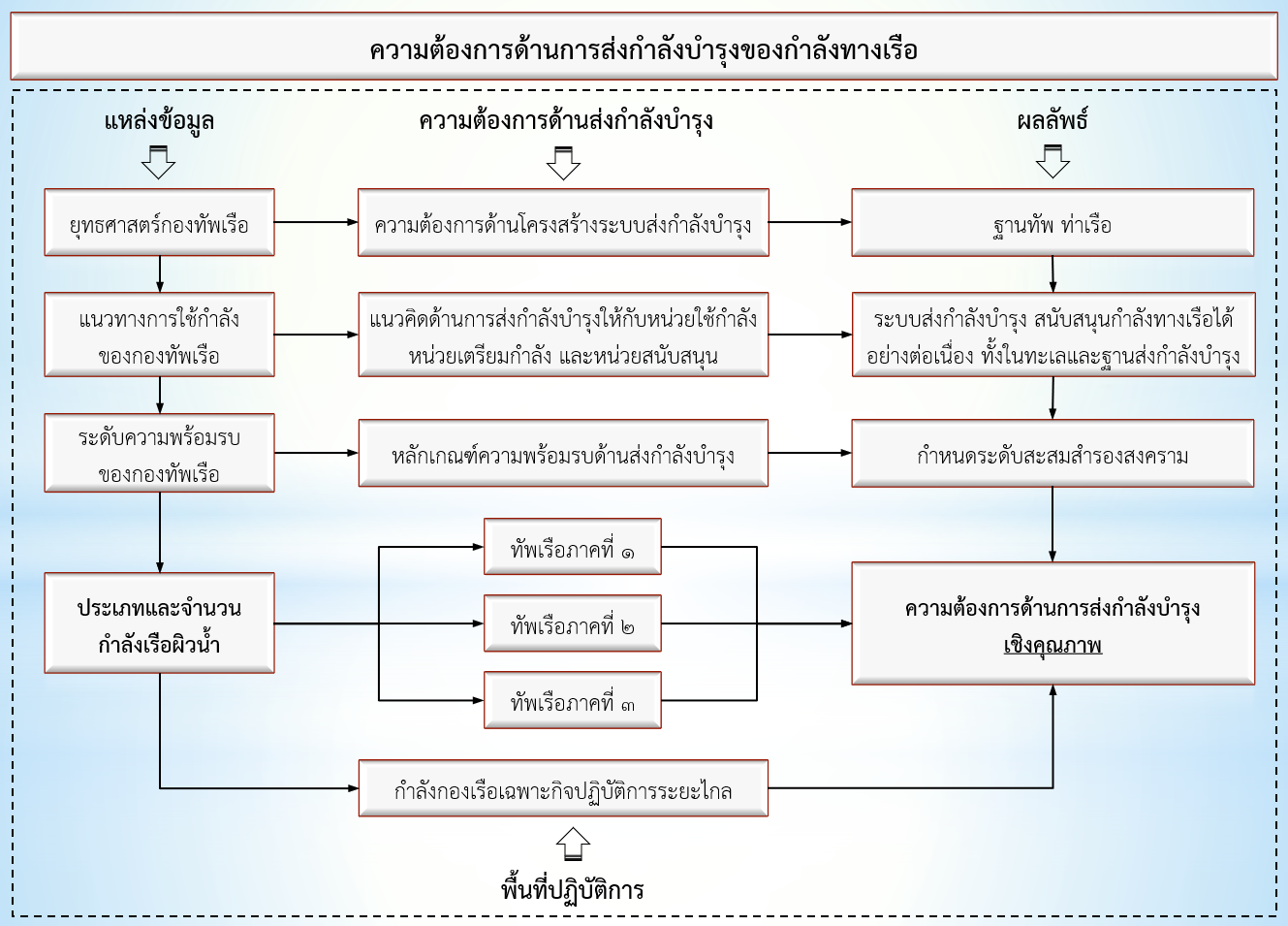
To address these requirements, the Royal Thai Navy has approved guidelines governing force employment and readiness levels in support of its strategic concepts and institutional roles. These guidelines are designed to ensure that naval forces possess the necessary capabilities to effectively achieve both core and mission-specific objectives. They define operational patterns and the deployment of naval forces into operational areas under normal conditions, as well as during periods of tension, conflict, and war. In addition, the guidelines specify force types and compositions and direct subordinate units to maintain a minimum readiness posture at Level P.2, enabling operations in crisis situations or contingency plans. Logistic readiness requirements are also established in accordance with logistics mission areas, mandating the stockpiling of essential supplies—such as food, fuel, and critical materiel—at designated wartime reserve levels.
The implementation of these force employment and readiness guidelines necessitates substantial logistic support capabilities to ensure that naval forces can sustain continuous and effective operations throughout the designated operational period. However, the current status of essential wartime materiel within the Royal Thai Navy remains constrained, particularly with respect to fuel reserves and critical items—materiel that is difficult to procure, costly, and characterized by long delivery lead times. Furthermore, limitations in support infrastructure from naval bases and ports further exacerbate these challenges. Such constraints may adversely affect the Navy’s ability to fulfill its missions in national defense, the protection of maritime sovereignty, and the security of sea lines of communication, from crisis response through full-scale national defense operations.
Accordingly, it is imperative to systematically develop logistic support capabilities that are aligned with the Royal Thai Navy’s force employment concepts and readiness levels. Such development is essential to ensuring sustained operational effectiveness and enabling the Navy to successfully accomplish its missions in an increasingly complex and demanding maritime security environment.
Downloads
Article Details

This work is licensed under a Creative Commons Attribution-NonCommercial-NoDerivatives 4.0 International License.
Articles in this journal are copyrighted by the Naval Strategic Studies Center, Naval Education Department, and published under the Creative Commons Attribution-NonCommercial-NoDerivatives 4.0 International (CC BY-NC-ND 4.0) license.
may be read and used for academic purposes, such as teaching, research, or citation, with proper credit given to the author and the journal.
Use or modification of the articles is prohibited without permission.
Statements expressed in the articles are solely the opinions of the authors.
Authors are fully responsible for the content and accuracy of their articles.
Any other republication of the articles requires permission from the journal.
References
กองทัพเรือ. (๒๕๖๐). การประเมินยุทธศาสตร์กองทัพเรือ พ.ศ.๒๕๖๐ - ๒๕๗๙.
สำนักนโยบายและแผน กรมยุทธการทหารเรือ, บันทึกข้อความ ลับที่สุด ที่ กห ๐๕๐๕.๒.๒/๑๖๐ ลงวันที่ ๘ ก.ย.๖๓ เรื่อง ขออนุมัติแนวทางการใช้กำลังของ ทร. พ.ศ.๒๕๖๓.
กรมยุทธการทหารเรือ, บันทึกข้อความ ลับมาก ที่ กห ๐๕๐๕.๒/๘๒ ลงวันที่ ๒๕ มิ.ย.๖๔ เรื่อง ขออนุมัติใช้ระดับความพร้อมรบของ ทร. (ปรับปรุง พ.ศ.๒๕๖๔) และหลักเกณฑ์ความพร้อมยุทโธปกรณ์หลักของ ทร.
กรมส่งกำลังบำรุงทหารเรือ, บันทึกข้อความ ลับมาก ที่ ต่อ กบ.ทร. เลขรับ ๖๖๑๘/๕๘ ลงวันที่ ๑๘ ส.ค.๕๘ เรื่อง ขออนุมัติแผนระดมสรรพกำลังของ ทร. และบัญชีระดมสรรพกำลังของ ทร.
ฐานทัพเรือสัตหีบ, คำแนะนำการใช้ท่าเรือ การท่าเรือสัตหีบ พ.ศ.๒๕๕๗.
ฐานทัพเรือสงขลา (๒๕๖๐), ระเบียบปฏิบัติประจำว่าด้วยการท่าเรือ ฐานทัพเรือสงขลา ทัพเรือภาคที่ ๒.
ฐานทัพเรือพังงา (๒๕๖๔), เอกสารประกอบการบรรยายสรุป สำหรับผู้บังคับบัญชาที่มาตรวจเยี่ยมหน่วย.
ฐานส่งกำลังบำรุงทหารเรือตราด (๒๕๖๑), รายงานการรับ-ส่งหน้าที่ผู้บังคับการฐานส่งกำลังบำรุงทหารเรือตราด ทัพเรือภาคที่ ๑.
สถานีเรือสมุย (๒๕๖๔), เอกสารประกอบการบรรยายสรุป รับการตรวจเยี่ยมหน่วยจาก ผบ.ฐท.สข.ทรภ.๒ เมื่อ ๖ พ.ย.๖๔.
สถานีเรือละงู (๒๕๖๔), เอกสารประกอบการบรรยายสรุป รับการตรวจเยี่ยมหน่วยจาก ผบ.ทรภ.๓ เมื่อ ๒๗ ม.ค.๖๔.
สถานีเรือระนอง (๒๕๖๔), เอกสารประกอบการบรรยายสรุป รับการตรวจเยี่ยมหน่วยจาก ผบ.ทรภ.๓ เมื่อ ๒๗ ม.ค.๖๔.
