
China’s Belt and Road Initiative (BRI): The Silk Road Economic Belt and the 21st-Century Maritime Silk Road
Article Sidebar
Main Article Content
Abstract
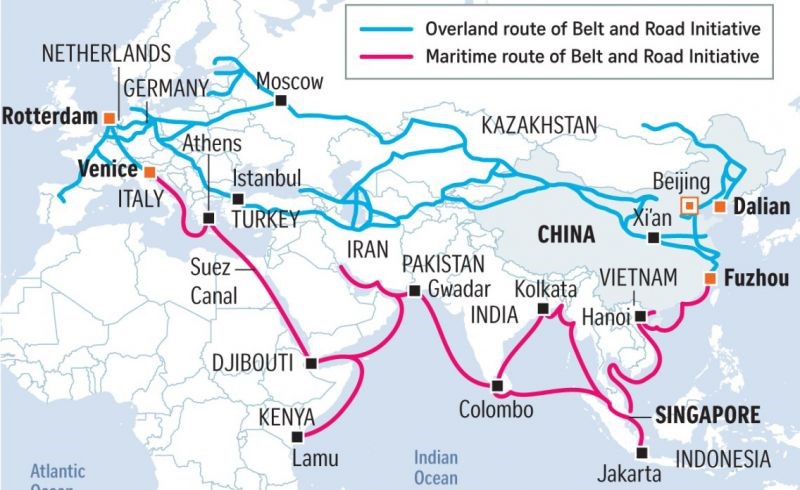
The Belt and Road Initiative (BRI) constitutes a policy framework for an extensive mega-project centered on cross-border investment through large-scale infrastructure development. It serves as China’s principal mechanism for linking its domestic economy with other economic regions across the globe, with the notable exception of the United States and Canada. The initiative is often portrayed as a vastly expanded and modernized extension of the ancient Silk Road. Announced by President Xi Jinping in 2013, the BRI has attracted participation from at least 147 countries to date. Operationally, the initiative has evolved around two primary components: overland connectivity and maritime connectivity. Significantly, the rise of the BRI may have incentivized the United States to develop the Free and Open Indo-Pacific (FOIP) strategy, to deepen cooperation with allies in Europe, North America, and South America, and to advance complementary policy frameworks such as the Build Back Better World (B3W) initiative.
This article proceeds from the assumption that China and the United States are competing for the position of the world’s preeminent power. China wields substantial economic influence in areas such as manufacturing, bond holdings, infrastructure investment, and a vast consumer market that draws businesses from around the world. Beijing has leveraged these capabilities to strengthen economic ties globally, with the Belt and Road Initiative serving as its flagship instrument. As a result, China’s influence has expanded across multiple regions. By contrast, the United States maintains its dominance through innovation, military power, technological leadership, regulatory capacity, large-scale financial institutions, and robust fiscal foundations. These capabilities enable Washington to shape international norms and institutions and to engage fully in strategic competition with China.
This article outlines the essential features of the Belt and Road Initiative to elucidate how China conceptualizes economic connectivity through the BRI, how it articulates its objectives, and how it translates these objectives into actionable strategies. The analysis draws on assessments from the Council on Foreign Relations (CFR), which reflect prevailing skepticism and mistrust regarding China’s intentions and the broader implications of the initiative.
Downloads
Article Details

This work is licensed under a Creative Commons Attribution-NonCommercial-NoDerivatives 4.0 International License.
Articles in this journal are copyrighted by the Naval Strategic Studies Center, Naval Education Department, and published under the Creative Commons Attribution-NonCommercial-NoDerivatives 4.0 International (CC BY-NC-ND 4.0) license.
may be read and used for academic purposes, such as teaching, research, or citation, with proper credit given to the author and the journal.
Use or modification of the articles is prohibited without permission.
Statements expressed in the articles are solely the opinions of the authors.
Authors are fully responsible for the content and accuracy of their articles.
Any other republication of the articles requires permission from the journal.
References
Asia Green Real Estate; News and Insight: “The Belt-and-Road initiative and the rising importance of China’s Western cities”, provide information about trends in the Asian real estate market, focuses on relevant economic topics highlighting the recent developments in the region.
Council on Foreign Relations, “China’s Massive Belt and Road Initiative”. (February 2023).
Asia Green Real Estate; News and Insight: https://www.asiagreen.com/en/news-insights/the-belt-and-road-initiative-and-the-rising-importance-of-china-s-western-cities
เชื่อว่าเป็นความริเริ่มที่แสวงประโยชน์จากการเปลี่ยนแปลงสภาพอากาศ ซึ่งน้ำแข็งในมหาสมุทรอาร์ติกละลายมากขึ้นในฤดูร้อนทำให้ใช้มหาสมุทรอาร์ติกเป็นเส้นทางเดินเรือขนส่งสินค้าได้ในทางเศรษฐกิจ ทั้งนี้ เส้นทางนี้มีช่องทางจำกัด (chokepoint) อยู่ที่ช่องแคบแบริ่ง (Bering Strait) ที่มีความกว้าง ๖๐ กม. อยู่ระหว่างคาบสมุทรซีวาร์ด (Seward Peninsula) ในมลรัฐอล้าสก้าของสหรัฐฯ กับคาบสมุทรชุคชิ (Chukchi Peninsula) ในเขตปกครองตนเองชูโกตา (chukota Autonomous Okrug) ของรัสเซีย
บทความของ CFR <https://www.cfr.org/backgrounder/chinas-massive-belt-and-road-initiative>. ครอบคลุมเนื้อหาหลายด้าน ได้แก่
- This CFR Independent Task Force report evaluates the implications of the BRI for U.S. interests and puts forward a U.S. strategy to respond to it.
- This Financial Times report on the BRI explores the political controversies—inside and outside China—that it has produced.
- This AidData study reviews one hundred Chinese debt contracts with foreign governments.
- The Wall Street Journal examines how China spent $1 trillion on BRI.
- CFR’s Belt and Road Tracker shows how the BRI has changed countries’ bilateral economic relationships with China over time.
- A National Bureau of Asian Research special report looks at how the BRI could affect China’s overall security strategy.
- The Center for Global Development’s Charles Kenny and Scott Morris argue that the United States shouldn’t copy BRI in this Foreign Affairs piece.
Asia Green Real Estate; News and Insight เรื่องเดียวกันระบุว่า “China’s East Coast became wealthy over the past decades thanks to its access to the sea and hence to global trade. Today, the Belt and Road (BR) initiative starts to link inland cities to the intercontinental trading routes. The augmented revival of the Silk Road raises the strategic importance of Chinas Western cities and further enhances their strong economic growth.”
ความร่วมมือที่มีอยู่ก่อนหน้า ซึ่งเกิดขึ้นล่าสุด คือ ความร่วมมือภาคี ๔ ชาติ (the Quad) พันธมิตรสหรัฐฯ-ออสเตรเลีย-สหราชอาณาจักร (AUKUS)
