การเรียนรู้แบบผสมผสานร่วมกับปัญญาประดิษฐ์ของนักเรียนมุสลิมชายขอบ มหานครเพื่อลดความเหลื่อมล้ำทางโอกาสในยุคดิจิทัล
คำสำคัญ:
การเรียนรู้แบบผสมผสาน, ปัญญาประดิษฐ์เพื่อการศึกษา, นักเรียนมุสลิมชายขอบกรุงเทพมหานคร, ความเหลื่อมล้ำทางโอกาสบทคัดย่อ
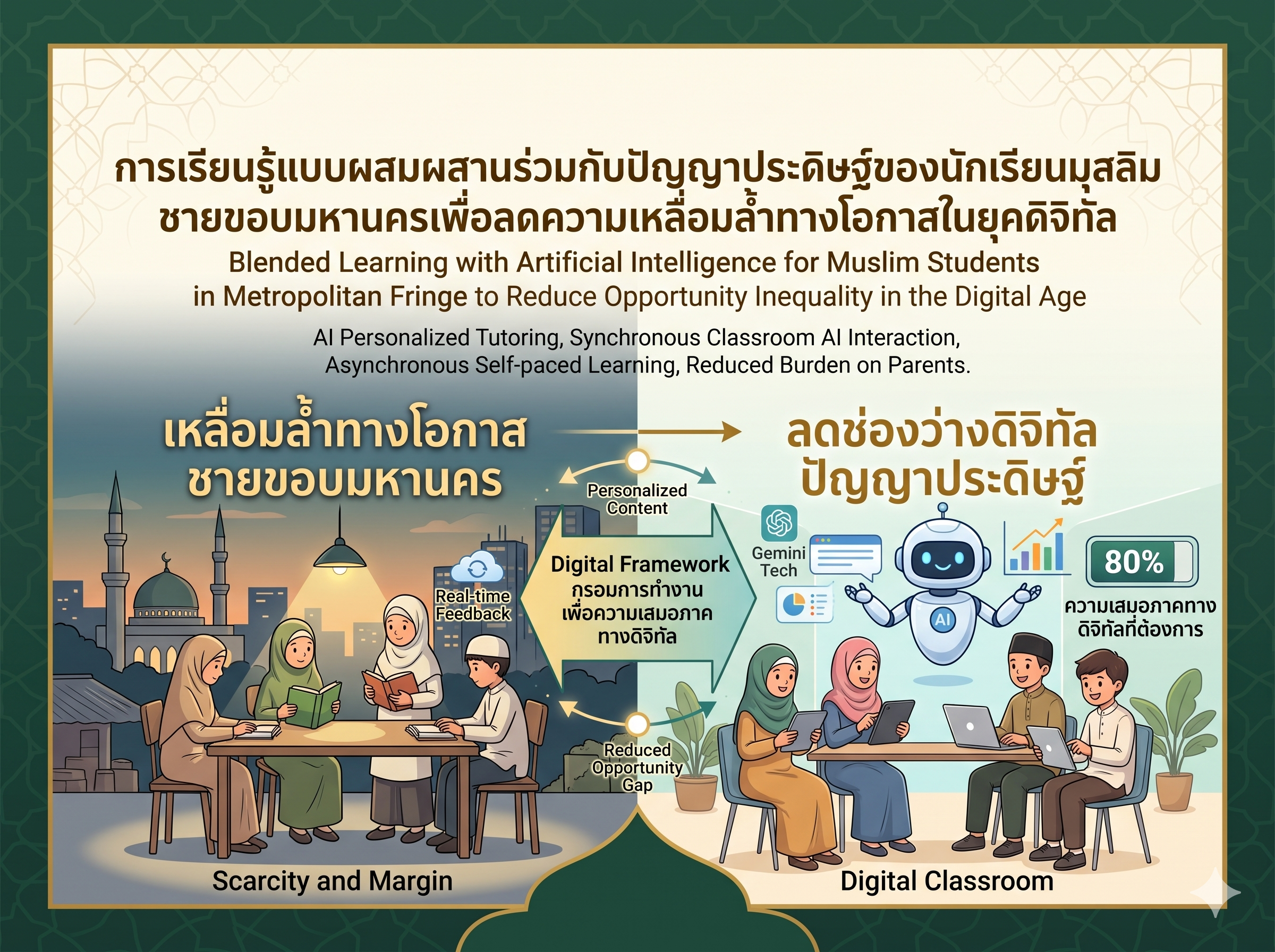
ความเหลื่อมล้ำทางการศึกษาในพื้นที่ชายขอบกรุงเทพมหานครเป็นปัญหาที่ถูกมองข้าม ท่ามกลางกระแสการพัฒนาปัญญาประดิษฐ์ (AI) นักเรียนมุสลิมในพื้นที่เขตหนองจอกยังคงเผชิญภาวะขาดแคลนทรัพยากร โดยเฉพาะเมื่อต้องแบกรับภาระการเรียนหลักสูตรสามัญและวิชาศาสนาควบคู่กัน บทความวิชาการนี้ จึงมีวัตถุประสงค์เพื่อนำเสนอแนวทางการใช้การเรียนรู้แบบผสมผสานร่วมกับปัญญาประดิษฐ์ (Blended Learning with AI) เพื่อลดช่องว่างดังกล่าว โดยการศึกษาเอกสารและสังเคราะห์แนวคิดบูรณาการเครื่องมือ AI เช่น Gemini และ ChatGPT เข้ากับกระบวนการเรียนรู้ ทั้งแบบประสานเวลา (Synchronous) และไม่ประสานเวลา (Asynchronous) ผลการสังเคราะห์ข้อเสนอแนะเชิงนโยบายชี้ให้เห็นว่า การใช้ AI เป็นครูผู้ช่วยส่วนตัว สามารถยกระดับความเข้าใจเนื้อหาได้ถึงระดับรายบุคคล (Personalized Learning) และลดภาระผู้ปกครองได้อย่างมีนัยสำคัญ ทั้งนี้ ภาครัฐจำเป็นต้องสนับสนุนโครงสร้างพื้นฐานทางดิจิทัลกว่าร้อยละ 80 ในพื้นที่ชายขอบ เพื่อให้การเข้าถึงทรัพยากรเกิดความเสมอภาคอย่างแท้จริง
เอกสารอ้างอิง
Allen, I. E., & Seaman, J. (2007). Online nation: Five years of growth in online learning. Sloan Consortium. https://files.eric.ed.gov/fulltext/ED529931.pdf
Bergmann, J., & Sams, A. (2012). Flip your classroom: Reach every student in every class every day. International Society for Technology in Education. https://www.iste.org/resources/product?id=2284
Crompton, H., Burke, C. P., & Gregory, K. H. (2017). The use of mobile learning in PK–12 education: A systematic review. Computers & Education, 110, 51–63. https://doi.org/10.1016/j.compedu.2017.03.013
KC, D., KC, P., Rado, I., & Vichit-Vadakan, N. (2025). Digital inequality and learning outcomes: Evidence from Thailand. Education and Information Technologies, 30(14), 19677–19702. https://doi.org/10.1007/s10639-025-13386-4
Miao, H., Holmes, W., Huang, R., & Zhang, H. (2021). AI and education: Guidance for policy-makers. UNESCO Publishing. https://unesdoc.unesco.org/ark:/48223/pf0000376709
Nguyen, L. V. (2025). Culturally responsive AI scaffolding in collaborative language education: Exploring sociocultural adaptations across diverse learning contexts. Journal of Posthumanism, 5(10), 353–367. https://doi.org/10.33182/joph.v5i10.3947
Office of Educational Technology. (2024). National educational technology plan: A call to action for closing the digital access, design and use divides. U.S. Department of Education. https://tech.ed.gov/netp
Staker, H., & Horn, M. B. (2012). Classifying K–12 blended learning. Innosight Institute. https://files.eric.ed.gov/fulltext/ED535180.pdf
Takaew, P., Tuntiwongwanich, S., Petsangsri, S., Meedee, C., Moto, S., & Pimdee, P. (2025). Blended FORCE model: Advancing collaborative, cloud-based learning in system design courses. International Journal of Instruction, 18(4), 75–88. https://doi.org/10.29333/iji.2025.1845a
Teepakakorn, K. (2025). Learning with AI in 2025: How Thai teachers adapt in the Generative AI era. Ratchasima Review, 1(2), 1–10. https://so09.tci-thaijo.org/index.php/RSMP/article/view/7157
Tsiloni, E., Dragioti, E., Gouva, M., Vassilopoulos, S. P., & Mentis, M. (2025). AI in personalized learning for older adults and intergenerational engagement: A systematic review. European Psychiatry, 68(1), 1–15. https://doi.org/10.1192/j.eurpsy.2025.1008
UNESCO. (2024). AI competency frameworks for teachers and students. UNESCO Publishing. https://unesdoc.unesco.org/ark:/48223/pf0000391105
กระทรวงการอุดมศึกษา วิทยาศาสตร์ วิจัยและนวัตกรรม. (2565). แผนปฏิบัติการด้านปัญญาประดิษฐ์แห่งชาติเพื่อการพัฒนาประเทศไทย (พ.ศ. 2565–2570). https://www.ai.in.th/wp-content/uploads/2022/12/2022-NAIS-Presentation-eng.pdf
กัญชลารักษ์ ทีปกากร. (2568). การเรียนรู้กับ AI ในปี 2568: ครูไทยปรับตัวอย่างไรในยุค Generative AI. วารสารราชสีมาปริทัศน์, 1(2), 1–10. https://so09.tci-thaijo.org/index.php/RSMP/article/view/7157
ดาวน์โหลด
เผยแพร่แล้ว
รูปแบบการอ้างอิง
ฉบับ
ประเภทบทความ
สัญญาอนุญาต
ลิขสิทธิ์ (c) 2026 Internatinal Islamic College Bangkok, Krik University

อนุญาตภายใต้เงื่อนไข Creative Commons Attribution-NonCommercial-NoDerivatives 4.0 International License.
วารสารที่ได้รับการตีพิมพ์เป็นลิขสิทธ์ของวิทยาลัยนานาชาติอิสลามกรุงเทพ มหาวิทยาลัยเกริก
ข้อความที่ปรากฎในบทความแต่ละเรื่องในวารสารวิชาการเล่มนี้เป็นความคิดเห็นส่วนตัวของผู้เขียนแต่ละท่านไม่เกี่ยวข้องกับวิทยาลัยนานาชาติอิสลามกรุงเทพ และคณาจารย์ท่านอื่น แต่อย่างใด ความรับผิดชอบองค์ประกอบทั้งหมดของบทความแต่ละเรื่องเป็นของผู้เขียน