Problems and Solutions of Bangkok Muslim Pilgrims in 2025: Historical, Cultural, and Islamic Jurisprudential Perspectives
คำสำคัญ:
Pilgrims, Thai Muslims, Islamic history, Islamic urisprudence (Fiqh), Islamic cultureบทคัดย่อ
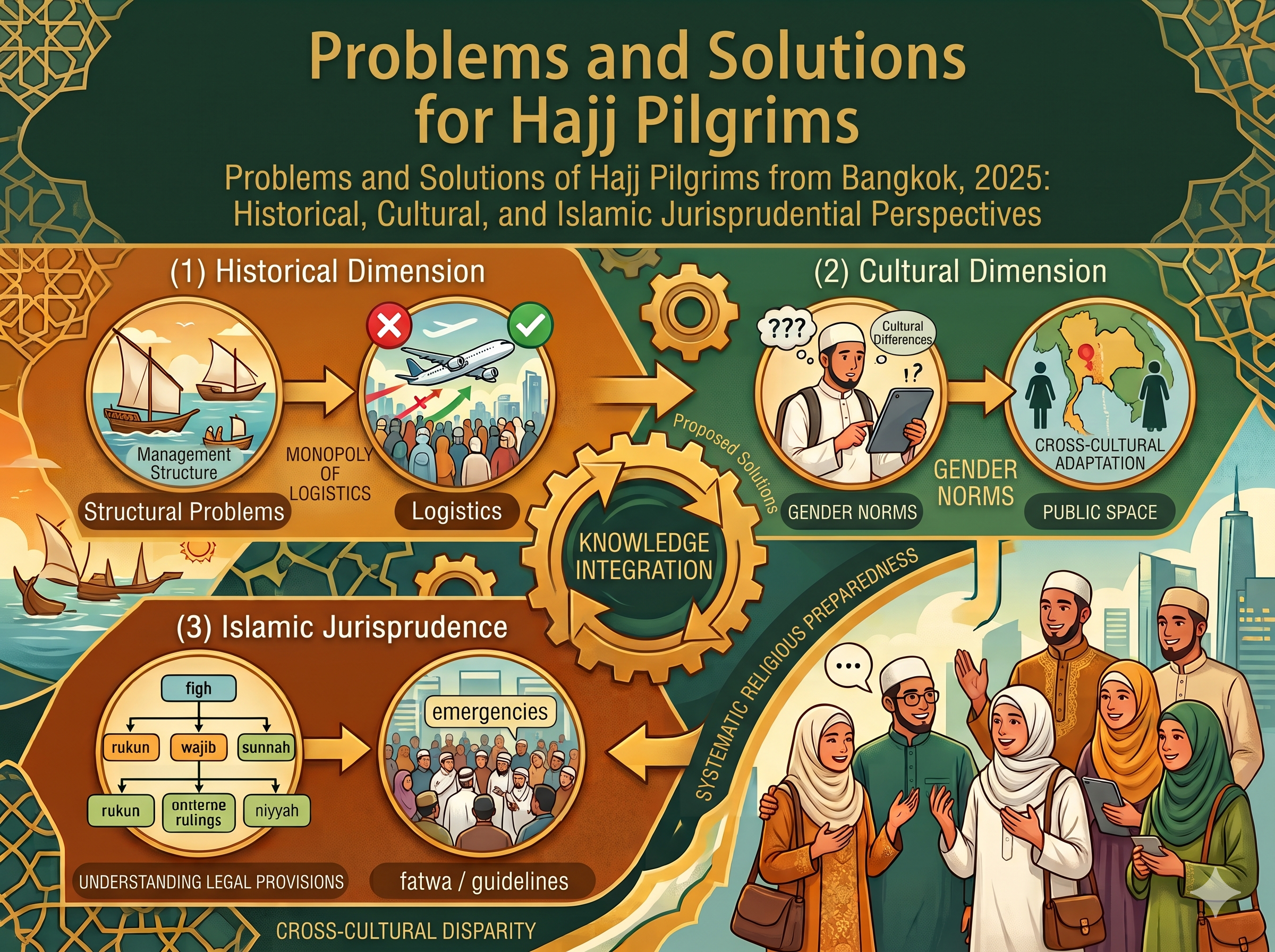
The performance of Hajj is one of the five pillars of Islam, which every Muslim who is physically and financially able must undertake at least once in their lifetime. This study aims to examine the problems and solutions facing Muslim pilgrims from Bangkok in 2025 by analyzing three dimensions: the historical dimension, the cultural dimension, and the dimension of Islamic jurisprudence. The research employs a qualitative methodology, collecting data from historical documents, texts of Islamic jurisprudence, and in-depth interviews with 10 pilgrims from Bangkok as well as 5 relevant officials. Data were analyzed using content analysis. The findings indicate that the main problems of pilgrims include (1) Structural problems inherited from historical models of Hajj management, (2) issues of cultural differences and cross-cultural communication, and (3) Problems of understanding Islamic legal provisions in contemporary social contexts. Proposed solutions should emphasize integrating knowledge from history, culture, and Islamic jurisprudence, as well as developing public policies and systematic religious preparedness. Reform the Hajj management system with state support for community and religious organizations; develop blended religious-practical pre-Hajj curricula; provide cross-cultural readiness training, language instruction, and simulations with an etiquette handbook; and offer practical fiqh courses, niyyah training, and fatwa-guidelines for emergencies.
เอกสารอ้างอิง
Abdullah, M. (2017). The ritual culture of Hajj among Thai Muslims. Journal of Islamic Studies, 12(2), 45–67.
Al-Qaradawi, Y. (1999). Fiqh al-hajj wa al-ʿumrah [Jurisprudence of Hajj and Umrah]. Maktabat Wahba.
Al-Zuhayli, W. (2005). Al-fiqh al-Islami wa adillatuh (Vol. 3). Dar al-Fikr. https://books.google.com/books?id=wA_YAAAAMAAJ
Azra, A. (2004). The origins of Islamic reformism in Southeast Asia: Networks of Malay-Indonesian and Middle Eastern 'ulama' in the seventeenth and eighteenth centuries. University of Hawaiʻi Press. https://uhpress.hawaii.edu/title/the-origins-of-islamic-reformism-in-southeast-asia/
Creswell, J. W. (2013). Qualitative inquiry and research design: Choosing among five approaches (3rd ed.). Sage. https://us.sagepub.com/en-us/nam/qualitative-inquiry-and-research-design/book235677
Hall, S. (Ed.). (1997). Representation: Cultural representations and signifying practices. Sage. https://uk.sagepub.com/en-gb/eur/representation/book234567
Hajj Affairs Division, Office of the Central Islamic Council of Thailand. (2024). Report on the management of Hajj in Thailand. Office of the Central Islamic Council of Thailand.
Ibn Qudamah. (1997). Al-Mughni. Dar al-Kutub al-'Ilmiyyah. https://books.google.com/books?id=yRghzQEACAAJ
Kamali, M. H. (2008). Shariah law: An introduction. Oneworld Publications. https://oneworld-publications.com/work/shariah-law/
Masud, M. K., Peters, R., & Powers, D. S. (Eds.). (2006). Hajj: Collected essays. Brill. https://brill.com/display/title/12088
Patton, M. Q. (2015). Qualitative research & evaluation methods: Integrating theory and practice (4th ed.). Sage. https://us.sagepub.com/en-us/nam/qualitative-research-evaluation-methods/book232962
Peters, F. E. (1994). The Hajj: The Muslim pilgrimage to Mecca and the holy places. Princeton University Press. https://press.princeton.edu/books/paperback/9780691026190/the-hajj
Roy, O. (2004). Globalized Islam: The search for a new Ummah. Columbia University Press. https://cup.columbia.edu/book/globalized-islam/9780231134994
Suchart, J. (2015). History of pilgrimage of Thai Muslims [In Thai]. University Press.
Turner, V. (1973). The center out there: Pilgrim's goal. History of Religions, 12(3), 191–230. https://doi.org/10.1086/462677
ดาวน์โหลด
เผยแพร่แล้ว
รูปแบบการอ้างอิง
ฉบับ
ประเภทบทความ
สัญญาอนุญาต
ลิขสิทธิ์ (c) 2026 Internatinal Islamic College Bangkok, Krik University

อนุญาตภายใต้เงื่อนไข Creative Commons Attribution-NonCommercial-NoDerivatives 4.0 International License.
วารสารที่ได้รับการตีพิมพ์เป็นลิขสิทธ์ของวิทยาลัยนานาชาติอิสลามกรุงเทพ มหาวิทยาลัยเกริก
ข้อความที่ปรากฎในบทความแต่ละเรื่องในวารสารวิชาการเล่มนี้เป็นความคิดเห็นส่วนตัวของผู้เขียนแต่ละท่านไม่เกี่ยวข้องกับวิทยาลัยนานาชาติอิสลามกรุงเทพ และคณาจารย์ท่านอื่น แต่อย่างใด ความรับผิดชอบองค์ประกอบทั้งหมดของบทความแต่ละเรื่องเป็นของผู้เขียน