Reforming Hajj Quota Allocation for Equity: Indonesia's Waiting Period Reduction Policy Under Law 14/2025
Keywords:
Hajj Quota, Equity, Distributive Justice, Indonesia LawAbstract
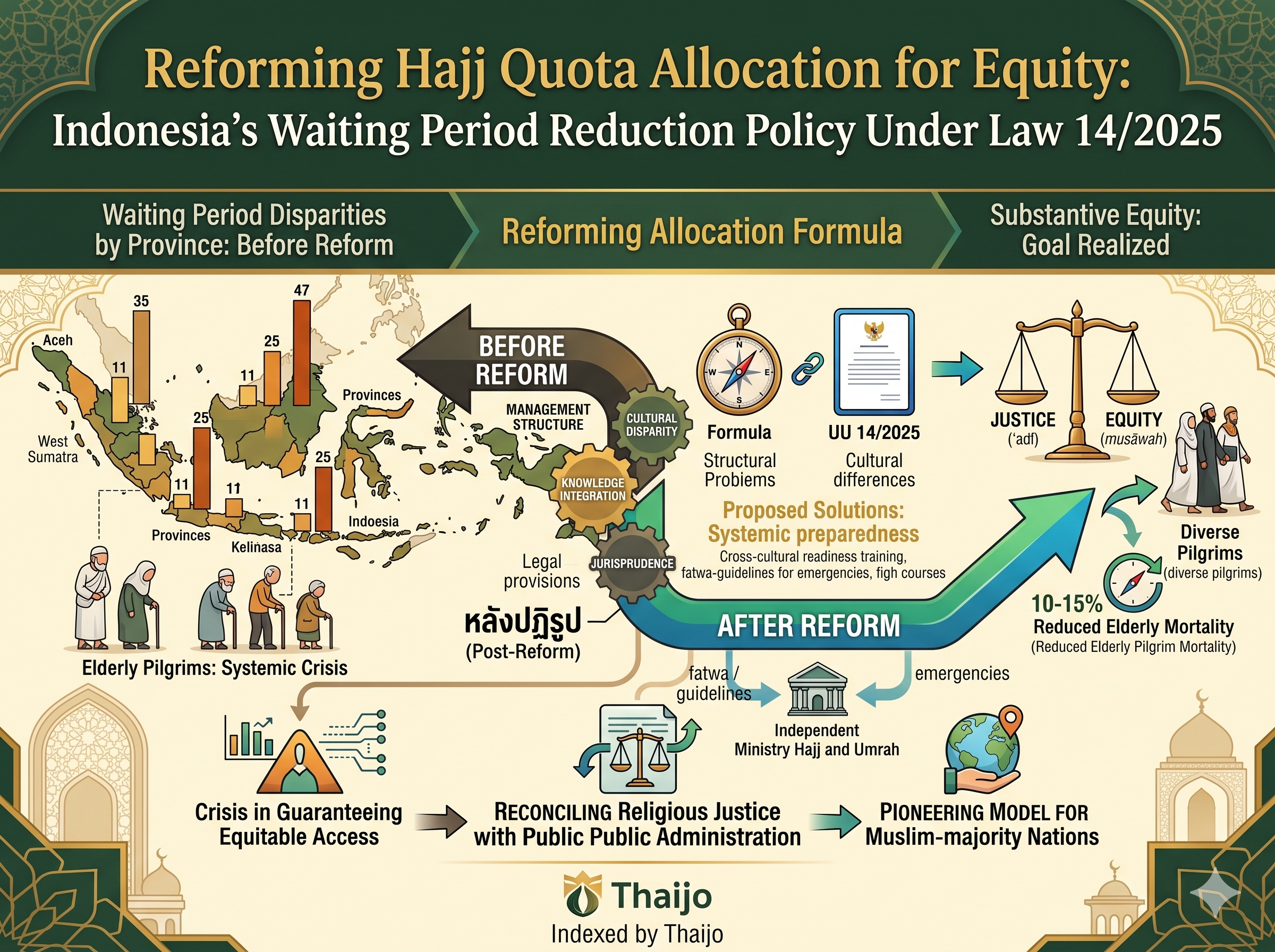
Indonesia faces a systemic Hajj crisis characterized by extreme regional disparities in waiting periods (11–47 years), which violate principles of equity in access to the fifth pillar of Islam. To resolve this, Law Number 14 of 2025 replaced the population-based quota system with a waiting-list proportion formula, standardizing the national average waiting period to 27 years. This study applies qualitative policy analysis, integrating Islamic governance principles (siyāsah sharʿīyah) with Grindle’s and Edwards’ implementation frameworks. Data were drawn from Law 14/2025, Ministry of Hajj and Umrah reports (2020–2026), and provincial quota statistics. Findings show a dual outcome. The policy enhances legal certainty and is projected to reduce elderly pilgrim mortality by 10–15% by accelerating departures in high-backlog provinces. However, it faces strong political resistance, particularly from West Java (loss of 9,083 slots), and technical challenges including 10% data inconsistencies in the SISKOHAT system. Despite infrastructural constraints, the reform marks a significant step toward substantive equity in Hajj management. It offers a pioneering model for other Muslim-majority nations in reconciling religious justice with modern public administration.
References
Abdal, A. (2021). Implementasi kebijakan tentang penyelenggaraan ibadah haji dalam upaya meningkatkan pelayanan jemaah haji di Kabupaten Garut. Jurnal Inovasi Penelitian, 2(1), 129–136. https://doi.org/10.47492/jip.v2i1.612
ADR Times. (2024, July 9). What is distributive justice? An overview. https://adrtimes.com/what-is-distributive-justice/
Al-Jawzīyah, M. ibn Abī Bakr ibn Qayyim. (1961). Al-Ṭuruq al-ḥukmīyah fī al-siyāsah al-sharʿīyah. Maktabat Dār al-Bayān. https://archive.org/details/alturuqalhukmyah00ibnquoft
Bloomberg Technoz. (2025, November 12). YLKI anggap redistribusi kuota haji tak adil. Bloomberg Technoz. https://www.bloombergtechnoz.com/detail-news/90177/ylki-anggap-redistribusi-kuota-haji-tak-adil
CNBC Indonesia. (2024, June 19). Baru daftar haji 2024, tahun berapa bisa berangkat ke Tanah Suci? CNBC Indonesia. https://www.cnbcindonesia.com/lifestyle/20240619094754-33-547370/baru-daftar-haji-2024-tahun-berapa-bisa-berangkat-ke-tanah-suci
Fater Land Transport Company. (2025, June 3). Hajj cost, subsidy, waiting list & Hajj quota country wise. https://fatertransport.com/Hajj-cost-subsidy-waiting-list-Hajj-quota-country-wise/
Fazil, F. (2024, April 25). Segini jumlah jamaah calon haji Indonesia tahun 2024. Radio Republik Indonesia. https://rri.co.id/info-haji/652955/segini-jumlah-jamaah-calon-haji-indonesia-tahun-2024
Fuadi, M. N. (2024). Analisis efektivitas sistem informasi komputerisasi haji terpadu (Siskohat) dalam penyelenggaraan ibadah haji pada Kantor Kementerian Agama Kabupaten Hulu Sungai Utara. Jurnal Administrasi Negara, 6(1), 344–354. https://ejurnal.stiaamuntai.ac.id/index.php/aliidarabalad/article/view/447
Grindle, M. S. (1980). Politics and policy implementation in the Third World. Princeton University Press. https://www.jstor.org/stable/j.ctt1m323qj
Huda, Q., & Haeba, I. D. (2021). Hajj, istitā’ah, and waiting list regulation in Indonesia. Al-’Adalah, 18(2), 193–212. https://doi.org/10.24042/adalah.v18i2.9903
Hussain, D. T. (2013, November 16). Justice and equality. The Quranic Teachings. https://quranicteachings.org/justice-and-equality/
Islahuddin, A. N., & Nandavita, A. Y. (2021). Pengaruh antrian haji terhadap minat masyarakat melaksanakan ibadah haji di Kota Metro. Multazam: Jurnal Manajemen Haji dan Umrah, 1(2), 99–112. https://doi.org/10.32332/multazam.v1i2.5374
Khafidhoh, K., Suhada, S., Sugito, S., Anggoro, S., & Mujahidin, I. (2025). The religious dilemma of prospective Hajj pilgrims facing waiting lists and Hajj costs at the Ministry of Religious Affairs in Kudus Regency 2024. Scaffolding: Jurnal Pendidikan Islam dan Multikulturalisme, 7(2), 272–285. https://doi.org/10.37680/scaffolding.v7i2.7224
Lamont, J., & Favor, C. (2017, September 26). Distributive justice. In E. N. Zalta (Ed.), The Stanford Encyclopedia of Philosophy. https://plato.stanford.edu/entries/justice-distributive/
Liman, U. S., & Fardaniah, R. (2025, November 28). Kemenhaj seragamkan masa tunggu calon haji Indonesia jadi 26,4 tahun. ANTARA News. https://www.antaranews.com/berita/5274533/kemenhaj-seragamkan-masa-tunggu-calon-haji-indonesia-jadi-264-tahun
Maiese, M. (2020, July). Distributive justice. Beyond Intractability. https://www.beyondintractability.org/essay/distributive_justice
Mardiyah, A. A., & Affandi, Y. (2025). Implementasi kebijakan istitaah haji di Dinas Kesehatan Kota Semarang (Sebagai upaya mengurangi risiko kematian jemaah). Jurnal Manajemen Pendidikan dan Ilmu Sosial, 6(2), 893–902. https://doi.org/10.38035/jmpis.v6i2.3678
Mazmanian, D. A., & Sabatier, P. A. (1983). Implementation and public policy. Scott, Foresman and Company. https://archive.org/details/implementationpu0000mazm
Mubarok, M. A., & Fuhaidah, U. (2018). Management of Hajj funds in the Republic of Indonesia (A study of collaboration between the Hajj fund management agency, the Ministry of Religious Affairs and financial partners in the management of Hajj funds). Iltizam Journal of Shariah Economic Research, 2, 67–88. https://e-journal.lp2m.uinjambi.ac.id/ojs/index.php/iltizam/article/view/165
Muneeza, A., Sudeen, A., Nasution, A., & Nurmalasari, R. (2018). A comparative study of Hajj fund management institutions in Malaysia, Indonesia and Maldives. International Journal of Management and Applied Research, 5(3), 120–134. https://doi.org/10.18646/2056.53.18-009
Munawaroh, Z., Mudhofi, M., & Susanto, D. (2017). Efektivitas sistem informasi dan komputerisasi haji terpadu (Siskohat) dalam penyelenggaraan ibadah haji. Jurnal Ilmu Dakwah, 35(2), 225–242. https://doi.org/10.21580/jid.v35.2.1608
Nugroho, R. (2017). Public policy: Dinamika kebijakan publik, analisis kebijakan publik, dan manajemen politik kebijakan publik (6th ed.). Elex Media Komputindo.
Puteri, S. R. Y., Anasom, A., Rozaq, A., Affandi, Y., & Muhajarah, K. (2025). Strategi dalam meningkatkan kualitas pelayanan jemaah haji khusus di PT. Dania Dzulqornain Jepara. Jurnal Manajemen Pendidikan dan Ilmu Sosial, 6(3), 2297–2308. https://doi.org/10.38035/jmpis.v6i3.4657
Rawls, J. (1971). A theory of justice. Harvard University Press. https://www.hup.harvard.edu/file/feeds/PDF/9780674000780_sample.pdf
Sarker, A. A. (1999). Islamic banking in Bangladesh: Performance, problems & prospects. International Journal of Islamic Financial Services, 1(3), 1–21.
Siregar, N. (2022). Menentukan model implementasi kebijakan dalam menganalisis penyelenggaraan pelatihan kepemimpinan administrator (PKA). JISOS: Jurnal Ilmu Sosial, 1(7), 713–722.
https://bajangjournal.com/index.php/JISOS/article/view/3320
Tangselpos. (2025, November 20). Kuota haji 2026, distribusi diubah, sudah tepat dan adilkah? Tangselpos. https://tangselpos.id/detail/42135/kuota-haji-2026-distribusi-diubah-sudah-tepat-dan-adilkah
Undang-Undang Republik Indonesia Nomor 14 Tahun 2025 tentang Perubahan Ketiga atas Undang-Undang Nomor 8 Tahun 2019 tentang Penyelenggaraan Ibadah Haji dan Umrah. (2025). https://peraturan.bpk.go.id/Details/331538/uu-no-14-tahun-2025
Van Uffelen, N., Goyal, N., & Martinez-Reyes, A. (2025). (Not) just policy success: Incorporating justice in policy evaluation. Policy Sciences, 58(3), 449–470. https://doi.org/10.1007/s11077-025-09588-3
Wandi, W. (2025, June 16). Mengenal inovasi Siskohat, sistem terintegrasi digital pelayanan jemaah haji. Info Publik. https://infopublik.id/kategori/layanan-publik/924604/index.html
Downloads
Published
How to Cite
Issue
Section
License
Copyright (c) 2026 Internatinal Islamic College Bangkok, Krirk University

This work is licensed under a Creative Commons Attribution-NonCommercial-NoDerivatives 4.0 International License.
All articles published in this journal are the copyright of International Islamic College Bangkok.
The opinions and statements expressed in each article are solely those of the respective authors and do not necessarily reflect the views or policies of International Islamic College Bangkokor its faculty members. The authors are solely responsible for the content and all components of their articles.