An Ensemble Multi-Model Approach for Stock Return Forecasting Integrating Emotion-Driven Feature Extraction and Time Series Prediction Based on Variational Autoencoders (VAE) and Temporal Fusion Transformers (TFT)
Article Sidebar
Main Article Content
บทคัดย่อ
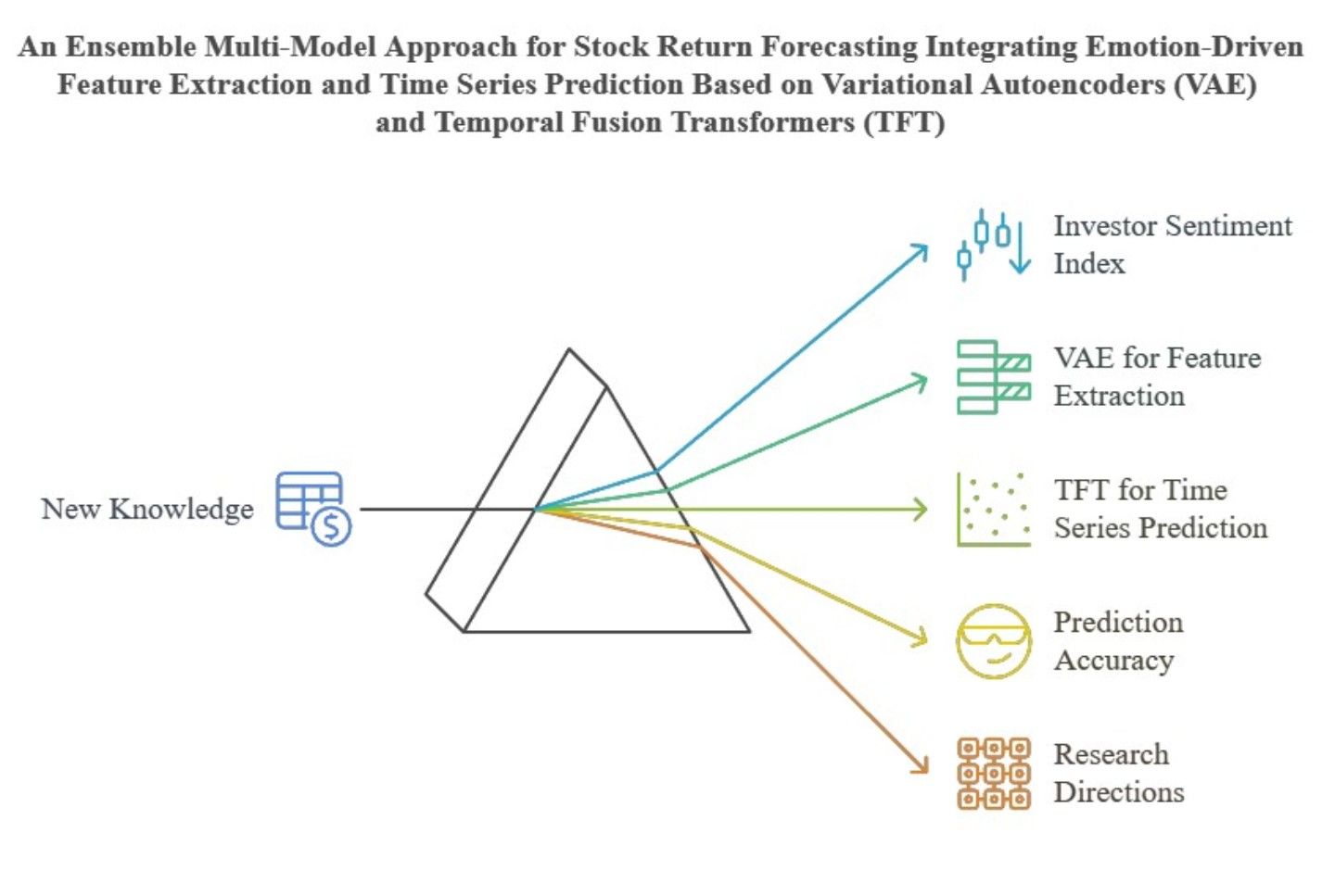
This article aimed to study: 1) the impact of investor sentiment on stock returns in the automotive industry, and 2) the development and validation of the Adaptive Sentiment-Enhanced Temporal Regression Model (ASTRM), an ensemble model integrating Variational Autoencoders (VAE), Temporal Fusion Transformers (TFT), and Ordinary Least Squares (OLS) regression. This quantitative research utilizes historical secondary data from 269 companies in the Chinese automotive industry. Data was collected from the China Stock Market & Accounting Research (CSMAR) database, comprising historical stock prices and a sentiment index derived from social media posts from May 23, 2019, to September 21, 2022. The statistical analysis involved: 1) using VAE for feature extraction and data denoising, 2) employing TFT with LSTM and multi-head attention mechanisms for time-series forecasting, and 3) applying OLS regression to optimize the final predictions. Model performance was evaluated using metrics such as accuracy and adjusted R-squared. The findings indicate that the ASTRM model achieved a prediction accuracy of 91.12%, significantly outperforming the traditional LSTM model (70.63%) and a model without denoising (77.48%). Furthermore, investor sentiment was found to have a statistically significant influence on stock returns (p-values < 0.001). The ASTRM also demonstrated faster convergence and a lower final loss value, enhancing overall predictive performance.
Article Details

อนุญาตภายใต้เงื่อนไข Creative Commons Attribution-NonCommercial-NoDerivatives 4.0 International License.
เอกสารอ้างอิง
Andleeb, R., & Hassan, A. (2023). Impact of investor sentiment on contemporaneous and future equity returns in emerging markets. Sage Open, 13(3), 21582440231193568.
Baker, M., & Stein, J. C. (2004). Market liquidity as a sentiment indicator. Journal of financial Markets, 7(3), 271-299.
Chen, C. (2022). Investor’s sentiment and stock return: an empirical study on the Thai Stock Market. (Master of Science, Chulalongkorn University).
CSMAR. (2025). Company financial Analysis. Retrieved from https://data.csmar.com/.
Mahmud, T., Karim, R., Chakma, R., Chowdhury, T., Hossain, M. S., & Andersson, K. (2024). A benchmark dataset for cricket sentiment analysis in bangla social media text. Procedia Computer Science, 238, 377-384.
McGurk, Z., Nowak, A., & Hall, J. C. (2020). Stock returns and investor sentiment: textual analysis and social media. Journal of Economics and Finance, 44(3), 458-485.
Shleifer, A. (2000). Inefficient Markets: An Introduction to Behavioral Finance. Oxford: Oxford University Press.
Yasser, F., Hatem, S., Ayman, L., Mohamed, L., & Mohammed, A. (2024). Data augmentation for sentiment analysis enhancement: A comparative study. In 2024 6th International Conference on Computing and Informatics (ICCI) (pp. 53-58). New York: IEEE.
Zhou, Y., Tu, F., Sha, K., Ding, J., & Chen, H. (2024). A survey on data quality dimensions and tools for machine learning invited paper. In 2024 IEEE International Conference on Artificial Intelligence Testing (AITest) (pp. 120-131). New York: IEEE.
