Work Motivation Affecting Organizational Commitment of Personnel at Nakhon Phanom University
Article Sidebar
Main Article Content
Abstract
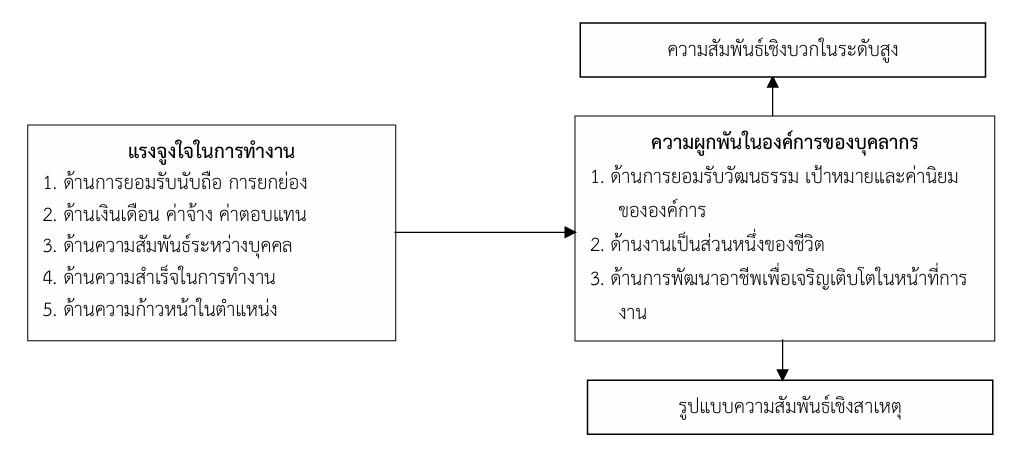
This article aimed to 1) study and compare work motivation of personnel classified by employment status and type of personnel, 2) study and compare organizational commitment of personnel classified by employment status and type of personnel, 3) examine the relationship between work motivation and organizational commitment of personnel, and 4) investigate work motivation factors that influence the organizational commitment of personnel. The sample consisted of 162 personnel of Nakhon Phanom University. The research instruments were: (1) a work motivation questionnaire, and (2) an organizational commitment questionnaire. The statistics used for data analysis were percentage, mean, standard deviation, independent-samples t-test, one-way analysis of variance (one-way ANOVA), Pearson’s product-moment correlation coefficient, and stepwise multiple regression analysis. The result of the study found that: 1) Overall, work motivation was at a high level. When classified by employment status, no significant differences were found in overall opinions. When classified by type of personnel, overall work motivation was also not significantly different; however, when considering each dimension, the dimension of salary, wage, and remuneration showed a statistically significant difference 2) Overall, organizational commitment was at a high level. The comparison by type of personnel revealed no significant difference in overall organizational commitment; however, when considering each dimension, the dimension of acceptance of the organization’s culture, goals, and values was significantly different 3) Work motivation of personnel and organizational commitment at Nakhon Phanom University were positively correlated at a high level And 4) The work motivation variables that affected the organizational commitment of personnel at Nakhon Phanom University comprised four dimensions: achievement in work (X4), salary, wage, and remuneration (X2), career advancement (X5), and recognition and appreciation (X1). These variables could significantly predict organizational commitment and jointly accounted for 83% of the variance.
Article Details

This work is licensed under a Creative Commons Attribution-NonCommercial-NoDerivatives 4.0 International License.
References
เกรียงศักดิ์ เจริญวงศ์ศักดิ์. (2558). ทิศทางการพัฒนาครูในศตวรรษที่ 21. กรุงเทพฯ: ซัคเซส มีเดีย.
เกียรติษฎา ภูมิเพ็ง. (2564). การศึกษาความต้องการและแรงจูงใจในการทำงานวิจัยสถาบันของบุคลากรสายสนับสนุนวิชาการ คณะวิทยาศาสตร์ มหาวิทยาลัยบูรพา (รายงานวิจัยฉบับสมบูรณ์). ชลบุรี: งานบุคลากรคณะเทคโนโลยี คณะวิทยาศาสตร์ มหาวิทยาลัยบูรพา.
จรรยา ชูทับ และ อรจันทร์ ศิริโชติ. (2567). ความผูกพันต่อองค์กรของบุคลากรสายสนับสนุน มหาวิทยาลัยทักษิณ. วารสารการจัดการและการพัฒนา มหาวิทยาลัยราชภัฏอุบลราชธานี, 11(1), 143–156.
ชัชพล ทรงสุนทรวงศ์ และ วิโรจน์ เจษฎาลักษณ์. (2559). อิทธิพลของแรงจูงใจในการทำงานและการรับรู้การสนับสนุนจากองค์การที่ส่งผลต่อความเป็นเลิศในการปฏิบัติงานของบุคลากรสำนักเทคโนโลยีการศึกษา มหาวิทยาลัยสุโขทัยธรรมาธิราช. วารสารอิเล็กทรอนิกส์การเรียนรู้ทางไกลเชิงนวัตกรรม, 6(1), 133–150.
ณัฏฐ์พัชร์ ลาภบำรุงวงศ์. (2562). การประยุกต์ทฤษฎีแรงจูงใจในการปฏิบัติงาน. วารสารวไลยอลงกรณ์ปริทัศน์ (มนุษยศาสตร์และสังคมศาสตร์), 9(2), 161–171.
ธัญญ์ชนาธร ธัญญ์ชัญญาธารก์, ศศิวิมล ฟองตา และ ทัศยาภรณ์ กาตาสาย. (2568). การศึกษาระดับความคิดเห็นของบุคลากรที่มีผลต่อความผูกพันต่อองค์กรในคณะเภสัชศาสตร์ มหาวิทยาลัยพะเยา. วารสารวิชาการ ปขมท., 14(3), e2469.
ธิริญญา เพ็ญญะ และ ไชยา ยิ้มวิไล. (2562). ความสัมพันธ์ระหว่างแรงจูงใจกับประสิทธิภาพในการปฏิบัติงานของบุคลากรในส่วนการศึกษา โรงเรียนนายร้อยพระจุลจอมเกล้า จังหวัดนครนายก. วารสารสหวิทยาการวิจัย: ฉบับบัณฑิต ศึกษา, 8(2), 153-161.
นิตยา ดานีสะมัน และ คึกฤทธิ์ ศิลาลาย. (2568). ความสัมพันธ์ระหว่างแรงจูงใจในการทำงานกับความผูกพันต่อองค์กรของครูสังกัดสำนักงาน คณะกรรมการส่งเสริมการศึกษาเอกชน พื้นที่กรุงเทพมหานคร กลุ่ม 16. วารสารวิเทศศึกษา มหาวิทยาลัยสงขลานครินทร์, 15(2), 42–54.
บงกช ตั้งจิระศิลป์. (2564). ความสัมพันธ์ระหว่างความผูกพันต่อองค์การ ความจงรักภักดีต่อองค์การ และผลการปฏิบัติงานของนักบัญชีในจังหวัดระยอง. วารสารบริหารธุรกิจอุตสาหกรรม, 3(2), 55-70.
บุญชม ศรีสะอาด.(2560). การวิจัยเบื้องต้น. (พิมพ์ครั้งที่10 ฉบับปรับปรุงใหม่). กรุงเทพฯ: สุวีริยาสาส์น.
ประพันธ์ ชัยกิจอุราใจ. (2560). คุณภาพชีวิตในการทำงานที่มีผลต่อความผูกพันต่อองค์การและประสิทธิภาพในการปฏิบัติงานของพนักงานในกลุ่มอุตสาหกรรมไฟฟ้าอิเล็กทรอนิกส์และโทรคมนาคม (รายงานการวิจัย). กรุงเทพฯ: วิทยาลัยบัณฑิตศึกษาด้านการจัดการ มหาวิทยาลัยศรีปทุม.
ปรัชญาภรณ์ แก้วรอด และ วนิชย์ ไชยแสง. (2566). ปัจจัยด้านแรงจูงใจที่มีอิทธิพลต่อความผูกพันต่อองค์กรของบุคลากรกรมการปกครองในเขตภาคตะวันออกเฉียงเหนือ. Journal of Roi Et Rajabhat University, 17(2), 188-199.
พรรษชล กลัดอ่ำ และ ศิริญญา วิรุณราช. (2567). ศึกษาปัจจัยที่มีความสัมพันธ์กับความผูกพันต่อองค์กรของบุคลากร มหาวิทยาลัยเทคโนโลยีราชมงคลธัญบุรี. วารสารศิลปะศาสตร์และอุตสาหกรรมบริการ, 7(2), 299-312.
มหาวิทยาลัยนครพนม. (2568). รายงานผลการดำเนินงานแผนพัฒนาทรัพยากรมนุษย์ มหาวิทยาลัยนครพนม ประจำปีงบประมาณ 2567. สืบค้นจาก https://www.npu.ac.th/files_upload/HRDP2024.pdf.
สมนึก ภัททิยธนี. (2567). การวัดผลการศึกษา. (พิมพ์ครั้งที่ 14). กาฬสินธุ์: ประสานการพิมพ์.
สุรางค์ โค้วตระกูล. (2559). จิตวิทยาการศึกษา. (พิมพ์ครั้งที่ 12). กรุงเทพฯ: จุฬาลงกรณ์มหาวิทยาลัย.
เสาวลักษณ์ คําวงษ์ และภูมิพิชัย ธารดํารงค์. (2567). แรงจูงใจในการทํางานและสภาพแวดล้อมในการทํางานที่ส่งผลต่อความผูกพันต่อองค์กรของพนักงานสายสนับสนุนมหาวิทยาลัยเกษตรศาสตร์. Procedia of Multidisciplinary Research, 2(10), 1-17.
อนุกูล ประดิษฐเขียน, เอนก ประดิษฐารมณ์ และ กิตติ ชุณหศรีวงศ์. (2567). ความสัมพันธ์ระหว่างความผูกพันต่อองค์กรกับแรงจูงใจในการทำงานของพนักงานบริษัทคอสเดนท์ จำกัด. วารสารศิลปการจัดการ, 8(4), 191–210.
เอมอร สิงห์พันธ์ และ พรเพชร ศรีเวียงยา. (2565). แรงจูงใจในการปฏิบัติงานของบุคลากร คณะศึกษาศาสตร์ มหาวิทยาลัยมหาสารคาม. วารสารศึกษาศาสตร์ มหาวิทยาลัยมหาสารคาม, 16(2), 222–233.
Abebe, A., & Assemie, A. (2023). Quality of work life and organizational commitment of the academic staff in Ethiopian universities. Heliyon, 9(4), e15139.
Herzberg, F. (1966). Work and the nature of man. Cleveland, OH: World Publishing.
Hosen, S., Hamzah, S. R., Ismail, I. A., Alias, S. N., Abd Aziz, M. F., & Rahman, M. M. (2024). Training & development, career development, and organizational commitment as the predictor of work performance. Heliyon, 10(1), e23903.
Huang, Y., Chen, X., Prempanichnukul, V., & Swatdikun, T. (2024). Compensation and commitment: Exploring the impact among early career staff in a University of Science & Engineering. Journal for Strategy and Enterprise Competitiveness, 3(7), 71–84.
Jung, G., & Moon, K.-K. (2024). Examining public service motivation’s impact on organizational commitment: Focusing on moderating roles of hygiene and motivation factors. Behavioral Sciences, 14(6), 476.
Manreal, G., Secretaria, N. M., Jesus, J. B., Delegencia, J. J., & Castillo, R. C. (2025). Examining organizational support practices and job characteristics in fostering employee commitment: A case study. Human Behavior, Development and Society, 26(3), 395–407.
May, D. R., Gilson, R. L., & Harter, L. M. (2004). The psychological conditions of meaningfulness, safety and availability and the engagement of the human spirit at work. Journal of Occupational and Organizational Psychology, 77(1), 11–37.
McAnally, K., & Hagger, M. S. (2024). Self-determination theory and workplace outcomes: A conceptual review and future research directions. Behavioral Sciences, 14(6), 428.
Robbins, S. P. (2003). Organizational behavior. (10th ed.). Upper Saddle River, NJ: Prentice Hall.
Woodruffe, C. (2006). The crucial importance of employee engagement. Human Resource Management International Digest, 14(1), 3–5.
