Training Behavior and Factors Affecting Training Participation Decisions of Private-Sector Employees in Thailand
Article Sidebar
Main Article Content
Abstract
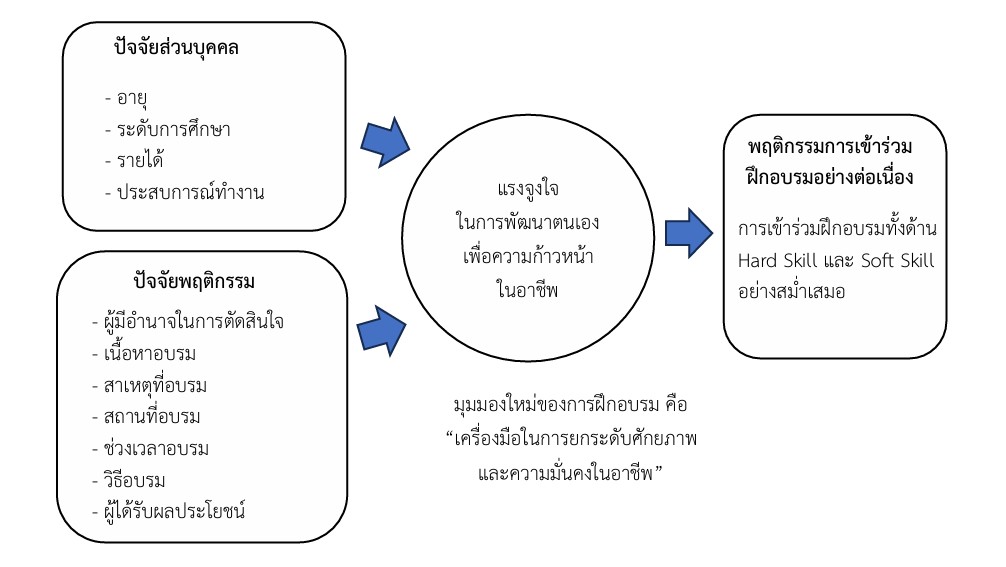
This study aimed to (1) examine the training behavior of private-sector employees and (2) analyze personal and behavioral factors influencing their decisions to participate in training. The research was conducted using a quantitative approach. The sample consisted of 400 private-sector employees selected through convenience sampling. Data were collected using an online questionnaire. Descriptive statistics, including frequency, percentage, mean, and standard deviation, and inferential statistics, including one-way ANOVA and multiple regression analysis, were used for data analysis. The results revealed that (1) training behavior across seven dimensions—decision influencers, training content, reasons for participation, training timing, training location, training type, and beneficiaries—was rated at the highest level. (2) Personal factors, including age, education level, income, and work experience, were significantly associated with decisions to participate in both hard-skill and soft-skill training, whereas gender showed no significant difference. Furthermore, behavioral factors indicated that decision authority, training content, reasons for participation, and training period significantly influenced decisions to participate in hard-skill training, while decision authority, training location, and training methods significantly influenced decisions to participate in soft-skill training. Therefore, private-sector organizations should develop training policies aligned with job characteristics and employee needs, taking into account differences in age, education, income, and work experience, and design appropriate training formats for both hard and soft skills to enhance sustainable human resource development.
Article Details

This work is licensed under a Creative Commons Attribution-NonCommercial-NoDerivatives 4.0 International License.
References
กิตติยา ฤทธิภักดี, อุใบ หมัดหมุด และ นิตยา แกสมาน. (2565). ปัจจัยที่มีผลต่อการตัดสินใจเข้าฝึกอบรมอาชีพกับวิทยาลัยชุมชนสตูล. วารสารครุศาสตร์ มหาวิทยาลัยราชภัฏยะลา, 1(2), 62–71.
ปรียานุช ดีพรมกุล. (2556). ปัจจัยที่มีอิทธิพลต่อการตัดสินใจเข้าฝึกอาชีพกรมพัฒนาฝีมือแรงงาน. (บริหารธุรกิจมหาบัณฑิต, มหาวิทยาลัยศรีปทุม).
ศิริวรรณ เสรีรัตน์. (2542). การบริหารเชิงกลยุทธ์ ฉบับมาตรฐาน. กรุงเทพฯ: Diamond in Business World.
ศิริวรรณ เสรีรัตน์. (2550). การจัดการและพฤติกรรมองค์การ. กรุงเทพฯ: บริษัท ธีระฟิล์ม และไซเท็กซ์ จํากัด.
Armstrong, M. (2009). Armstrong’s Handbook of Human Resource Management Practice. (11th ed.). London: Kogan Page.
Bassanini, A., Booth, A. L., Brunello, G., De Paola, M., & Leuven, E. (2005). Workplace training in Europe, IZA Discussion Papers, No. 1640. Bonn: Institute for the Study of Labor (IZA).
Becker, G. S. (2024). Human Capital: A Theoretical and Empirical Analysis, with Special Reference to Education Midway reprint. (3rd ed.). Chicago: University of Chicago Press.
Cochran, W.G. (1977). Sampling Techniques. (3rd Edition). New York: John Wiley & Sons.
Cronbach, L. J. (1970). Essentials of Psychological Testing. New York: Harper & Row.
Eisenberger, R., Huntington, R., Hutchison, S., & Sowa, D. (1986). Perceived organizational support. Journal of Applied psychology, 71(3), 500–507.
Goldstein, I. L., & Ford, J. K. (2002). Training in Organizations: Needs Assessment, Development, and Evaluation. (4th ed.). Wadsworth: Thomson Learning.
Han, H., Kim, W., & Hyun, S. S. (2011). Switching intention model development: Role of service performances, customer satisfaction, and switching barriers in the hotel industry. International Journal of Hospitality Management, 30(3), 619-629.
Kotler, P., & Keller, K. L. (2016). Marketing Management. (15th global edition). Edinburgh: Pearson Education.
Noe, R. (2017). Employee training and development. (7th ed.). New York: McGraw Hill Education.
Rovinelli, R.J. & Hambleton, R.K. (1977). On the Use of Content Specialists in the Assessment of Criterion-Referenced Test Item Validity. Tijdschrift Voor Onderwijs Research, 2, 49-60.
Salas, E., Tannenbaum, S. I., Kraiger, K., & Smith-Jentsch, K. A. (2012). The science of training and development in organizations. Psychological Science in the Public Interest, 13(2), 74–101.
