Technology Acceptance and Service Quality that Affect Loyalty in Choosing Grab Food Application Services in Hat Yai District, Songkhla Province
Article Sidebar
Main Article Content
Abstract
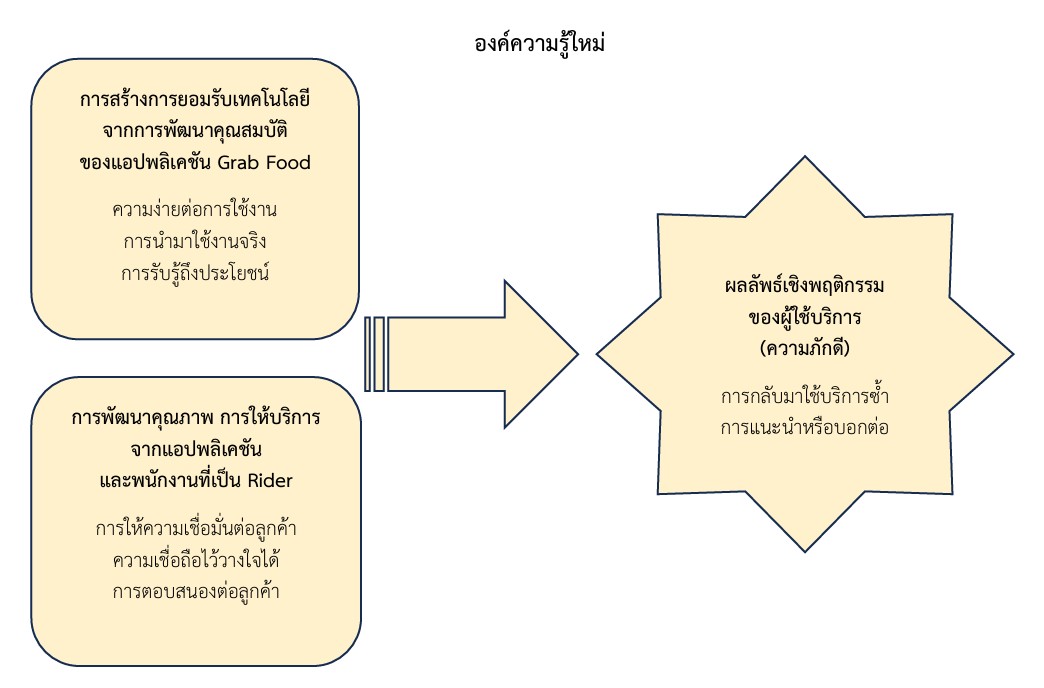
The objectives of this study were to (1) examine the influence of technology acceptance on customer loyalty in the utilization of the Grab Food application in Hat Yai District, Songkhla Province, and (2) investigate the impact of service quality on customer loyalty in the utilization of the Grab Food application in the same area. A quantitative research design was employed. The sample comprised 385 customers who had experience using the Grab Food service, selected through purposive sampling. The research instrument was a structured questionnaire consisting of multiple-choice items and a five-point Likert scale. Data were analyzed using both descriptive statistics, including percentages, means, and standard deviations, and inferential statistics, such as correlation and multiple regression analyses. The findings revealed that technology acceptance-comprising perceived usefulness, perceived ease of use, and actual usage-exerted a positive influence on customer loyalty toward the Grab Food application, with statistical significance at the 0.05 level. Similarly, service quality factors-comprising reliability, responsiveness, and assurance-were found to have a positive influence on customer loyalty toward the Grab Food application, also at the 0.05 significance level.
Article Details

This work is licensed under a Creative Commons Attribution-NonCommercial-NoDerivatives 4.0 International License.
References
กานต์สิริ ชัยมงคล และ ปาลิตา ชิตพิทักษ์. (2566). กลยุทธ์ส่วนประสมทางการตลาดและการตลาดเชิงประสบการณ์ที่ส่งผลต่อความภักดีของลูกค้าในการซื้อหมูย่างเมืองตรัง. ใน การประชุมวิชาการระดับชาติและนานาชาติ ครั้งที่ 3. (น. 297-315). สมุทรปราการ: มหาวิทยาลัยเซาธ์อีสท์บางกอก.
ธนาศักดิ์ ข่ายกระโทก, สิริมา บูรณ์กุศล และ กนกกาญจน์ ศรีสุรินทร์. (2560). พฤติกรรมการเลือกซื้อสินค้าออนไลน์ของผู้บริโภคในจังหวัดอุบลราชธานี. ใน การประชุมวิชาการและนำเสนอผลงานวิจัยระดับชาติ ราชธานีวิชาการ ครั้งที่ 2 (น. 1189-1200). อุบลราชธานี: มหาวิทยาลัยอุบลราชธานี.
ธิดา อิงคสฤษฎ์ และ ฉัตรพล ไขแสงทอง. (2563). ปัจจัยที่มีผลต่อความภักดีในการซื้อสินค้าและบริการผ่านออนไลน์ของคนเจเนเรชั่นเอ็กซ์. วารสารสุทธิปริทัศน์, 34(110), 159-170.
นิตยา มาช้าง. (2566). คุณภาพบริการที่ส่งผลต่อความจงรักภักดีของลูกค้าร้านสวนคุณตา อำเภอฝาง จังหวัดเชียงใหม่. (บริหารธุรกิจมหาบัณฑิต, มหาวิทยาลัยแม่โจ้).
ประมวล มียอด. (2561). คุณภาพบริการที่ส่งผลต่อความภักดีของลูกค้าในการใช้บริการตรวจสอบ. (บริหารธุรกิจมหาบัณฑิต, มหาวิทยาลัยเทคโนโลยีราชมงคลธัญบุรี).
ภุชงค์ สุภาสาคร, ฐานิดา จิตรสุภาพ และ เอกสิทธิ์ พัชรวงค์ศักดา. (2562). การยอมรับเทคโนโลยีและความภักดีทางอิเล็กทรอนิกส์ของแอปพลิเคชันขนส่งอาหารออนไลน์ของผู้บริโภคในเพศหญิงในเขตกรุงเทพมหานคร. วารสารบริหารธุรกิจและสังคมศาสตร์, 2(3), 141-155.
ลัดดาวัลย์ อรุณเลิศ. (2565). ปัจจัยคุณภาพการให้บริการที่มีผลต่อความพึงพอใจและการกลับมาใช้บริการซ้ำของลูกค้าแอปพลิเคชันฟู้ดแพนด้า. วารสารศึกษาศาสตร์ มหาวิทยาลัยมหามงกุฏราชวิทยาลัย, 10(1), 130-143.
วสุธิดา นุริตมนต์. (2564). การรับรู้คุณภาพผลิตภัณฑ์และคุณภาพการบริการที่มีอิทธิพลต่อการใช้บริการซ้ำร้านอาหารญี่ปุ่น. วารสารวิชาการและวิจัย มหาวิทยาลัยภาคตะวันออกเฉียงเหนือ, 11(3), 11-23.
ศิริมา แก้วเกิด, ภคพล สุนทรโรจน์, ปริพัฒน์ ปัทมรีย์ และ จักรพันธ์ สาตมุณี. (2565). การยอมรับเทคโนโลยีแอปพลิเคชัน Shopee ที่ส่งผลต่อความภักดีของลูกค้าในการซื้อสินค้าออนไลน์. วารสารการบัญชีและการจัดการ มหาวิทยาลัยมหาสารคาม, 15(2), 96-111.
ศูนย์วิจัยกสิกรไทย. (2566). การแข่งขันของแอปพลิเคชันสั่งอาหาร. สืบค้นจาก https://www.kasikornresearch.com/th/analysis/k-econ/business/Pages/z2995.aspx.
ศูนย์วิจัยกสิกรไทย. (2567). ตลาด Food Delivery ปี 2567 ยังมีเทรนด์ที่ลดลงต่อเนื่อง. สืบค้นจาก https://www.kasikornresearch.com/th/analysis/k-econ/business/Pages/Food-Delivery-CIS3452-02-02-2024.aspx.
สมชาย เล็กเจริญ และ ชุติธารรัฐ อุตมะสิริเสนี. (2565). ปัจจัยคุณภาพการให้บริการและการยอมรับเทคโนโลยีที่ ส่งผลต่อความพึงพอใจ และความภักดีของผู้ใช้บริการ. วารสารสหวิทยาการมนุษย์และสังคมศาสตร์, 5(3), 994-1008.
สุธาสินี ตุลานนท์. (2562). การยอมรับเทคโนโลยีที่มีผลต่อการตัดสินใจซื้อสินค้าออนไลน์ของผู้สูงอายุ. (บริหารธุรกิจมหาบัณฑิต มหาวิทยาลัยนเรศวร).
สุวัจนี เพชรรัตน์, ฟาริดา ซาซา และ ณรงค์ศักดิ์ รอบคอบ. (2564). ส่วนประสมทางการตลาดและพฤติกรรมการซื้อผ่านแอปพลิเคชันสั่งอาหารของผู้บริโภคในเขตเทศบาลนครหาดใหญ่. วารสารมหาจุฬานาครทรรศน์, 8(8), 61-76.
อรทัย จันทร, สุวัฒน์ สังคนันท์ และ วิศิษฐ์ ฤทธิบุญไชย. (2564). อิทธิพลต่อการยอมรับการใช้เทคโนโลยีผ่านแอปพลิเคชันส่งอาหารของผู้บริโภคในเขตกรุงเทพมหานครและปริมณฑล. RMUTT Global Business and Economics Review, 16(1), 82-92.
Belsley, D. A. (1991). A guide to using the collinearity diagnostics. Computer Science in Economics and Management, 4(1), 33-50.
Bourdeau, B. L. (2005). A new examination of service loyalty: Identification of the antecedents and outcomes of an attitudinal loyalty framework. (Doctor of Philosophy, The Florida State University).
Chu, A. Z. C., & Chu, R. J. C. (2011). The intranet's role in newcomer socialization in the hotel industry in Taiwan–technology acceptance model analysis. The International Journal of Human Resource Management, 22(05), 1163-1179.
Cochran, W.G. (1977). Sampling Techniques. (3rd ed.). New York: Wiley.
Parasuraman, A., & Berry, L. L. (1990). Delivering quality service: Balancing customer perceptions and expectations. New York: Free Press.
