A study of statistical data to analyze community Inequality in Roi Et province with machine learning
Article Sidebar
Main Article Content
Abstract
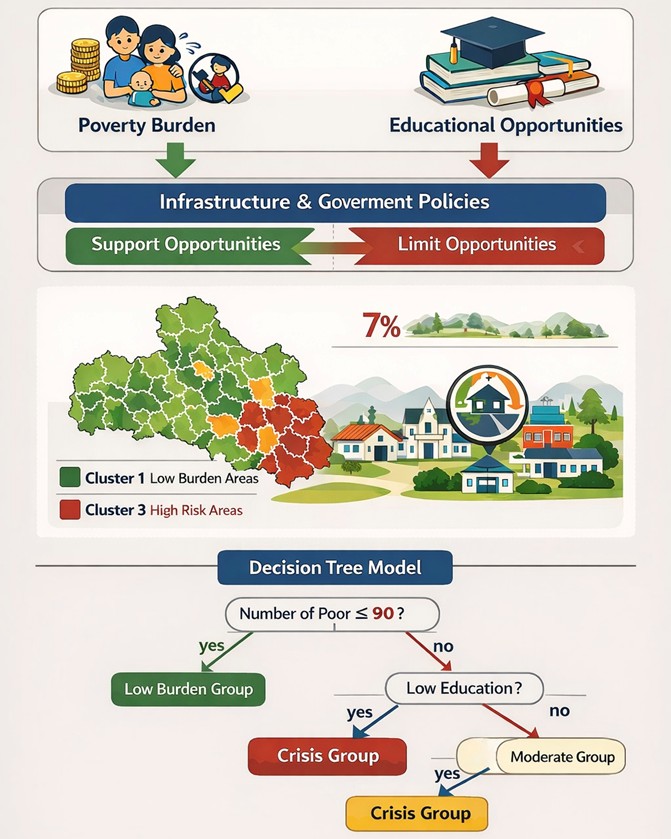
This article aimed to study: (1) the characteristics of community-level inequality in Roi Et Province, (2) the analysis of data using statistical methods and machine learning techniques to identify key factors influencing inequality, and (3) the proposal of systematic policies and local development guidelines. This study employed a mixed-methods approach, utilizing both primary data from household surveys and secondary data from relevant governmental agencies. Data collection instruments included household questionnaires and statistical records, while data analysis employed descriptive statistics, K-Means clustering, and decision tree modeling. The findings revealed that: (1) the sample group in Tha Muang Subdistrict, Selaphum District, had a low average monthly income (9,500 Baht) and perceived inequality at a high level, particularly regarding income and access to public services; (2) K-Means clustering classified the study areas into three levels of inequality: low, medium, and critical, with Kaset Wisai District identified as the most critical area due to having the highest number of poor households; and (3) decision tree modeling indicated that the “number of poor households” and “education” were the most influential variables in determining inequality levels. These findings provide an empirical basis for designing targeted policy interventions, such as improving education, developing infrastructure, and enhancing access to welfare, thereby fostering equity and long-term sustainable development.
Article Details

This work is licensed under a Creative Commons Attribution-NonCommercial-NoDerivatives 4.0 International License.
References
ผดุงชาติ ฟองนารี และ อลงกรณ์ อรรคแสง. (2567). สภาพปัญหาและข้อเสนอแนะในการอภิบาลน้ำภายในเขตพื้นที่จังหวัดร้อยเอ็ดและจังหวัดยโสธร. วารสารสังคมศาสตร์เพื่อการพัฒนาท้องถิ่น มหาวิทยาลัยราชภัฏมหาสารคาม, 8(1), 311-322.
พงศกร ชาวดง, พงศ์สวัสดิ์ ราชจันทร์ และ รพีพร ธงทอง. (2568). บทบาทผู้นำชุมชนในการจัดการกองทุนหมู่บ้าน กรณีศึกษา บ้านหนองหญ้าม้า ตำบลในเมือง อำเภอเมือง จังหวัดร้อยเอ็ด. วารสารเมธีวิจัย, 2(2), 51–62.
สำนักงานสภาพัฒนาการเศรษฐกิจและสังคมแห่งชาติ. (2564). รายงานการพัฒนาคนและสังคมไทย. กรุงเทพฯ: สำนักงานสภาพัฒนาการเศรษฐกิจและสังคมแห่งชาติ.
Alpaydin, E. (2020). Introduction to machine learning. (4th ed.). Cambridge: MIT Press.
Creswell, J. W. (2014). Research Design: Qualitative, Quantitative, and Mixed Methods Approaches. (4th ed.). Thousand Oaks, CA: Sage.
Jordan, M. I., & Mitchell, T. M. (2015). Machine learning: Trends, perspectives, and prospects. Science, 349(6245), 255-260.
Mitchell, T.M. (1997). Machine Learning. New York: McGraw-Hill.
Patton, M. Q. (2015). Qualitative research & evaluation methods: Integrating theory and practice. (4th ed.). Thousand Oaks, CA: Sage.
Piketty, T. (2014). Capital in the twenty-first century. London: Harvard University Press.
Surasvadi, N., Ruchikachorn, P., Siripanpornchana, C., Thajchayapong, S., & Plangprasopchok, A. (2019). Tpmap: a data analytics and visualization platform to support Thailand target poverty alleviation programs. In 2019 IEEE Pacific Visualization Symposium (PacificVis) (pp. 331-332). Bangkok, Thailand: IEEE Pacific Visualization Symposium.
Wiraphanphong, A. (2020). A study of multidimensional poverty management in Thailand according to the Thai People Map and Analytics Platform (TPMAP) through provincial budget allocation and provincial groups, annual budget 2017–2019. (Doctor of Public Administration, National Institute of Development Administration).
World Bank. (2020). Poverty and Shared Prosperity 2020: Reversals of Fortune. Washington, DC: World Bank.
