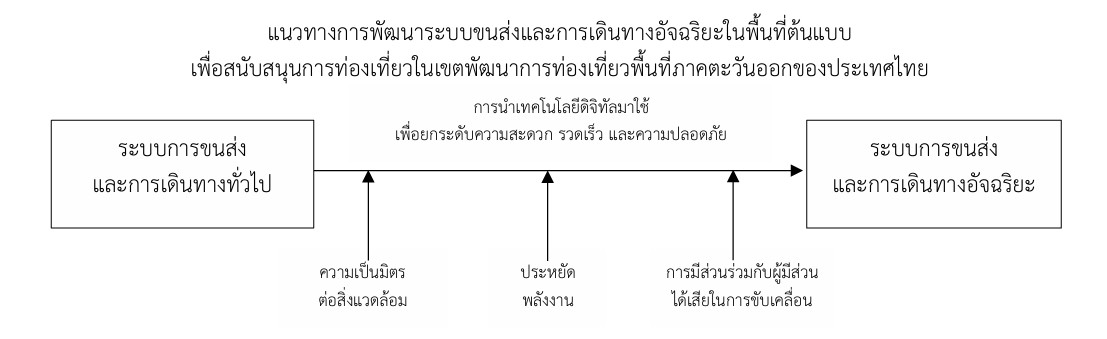
แนวทางการพัฒนาระบบขนส่งและการเดินทางอัจฉริยะในพื้นที่ต้นแบบ เพื่อสนับสนุนการท่องเที่ยวในเขตพัฒนาการท่องเที่ยวพื้นที่ภาคตะวันออกของประเทศไทย
Article Sidebar
Main Article Content
บทคัดย่อ
การศึกษานี้มีวัตถุประสงค์เพื่อศึกษาความต้องการ รูปแบบการพัฒนาระบบขนส่งและการเดินทางอัจฉริยะ และเสนอแนะแนวทางการพัฒนาระบบขนส่งและการเดินทางอัจฉริยะในพื้นที่ต้นแบบในเขตพัฒนาการท่องเที่ยวพื้นที่ภาคตะวันออกของประเทศไทยโดยใช้การวิจัยแบบผสมผสานทั้งการวิจัยเชิงคุณภาพและเชิงปริมาณ ผลการศึกษาพบว่า เขตพัฒนาการท่องเที่ยวทะเลตะวันออกหรือแอคทีฟบีชเป็นเขตพัฒนาการท่องเที่ยวที่มีศักยภาพมากที่สุดในการพัฒนาการขนส่งอัจฉริยะเพื่อการท่องเที่ยวเมื่อเทียบกับเขตพัฒนาอื่นในเขตพัฒนาการท่องเที่ยวพื้นที่ภาคตะวันออก แนวเส้นทางของระบบขนส่งที่เป็นไปได้มากที่สุดในพื้นที่ควรใช้จังหวัดชลบุรี โดยเฉพาะเมืองพัทยา เนื่องจากมีความพร้อมด้านนโยบาย โครงสร้างพื้นฐาน และปริมาณการท่องเที่ยว เส้นทางการเดินทางที่เสนอควรเริ่มต้นหรือจุดสิ้นสุดที่เมืองพัทยาที่เชื่อมไปยังพื้นที่รองอื่น ๆ ตามแนวแหล่งท่องเที่ยวริมทะเล การขับเคลื่อนการขนส่งและการเดินทางอัจฉริยะในพื้นที่ต้นแบบประกอบด้วยแผนงาน 3 ด้าน ซึ่งขับเคลื่อนโดยหน่วยงานภาครัฐในส่วนกลางและหน่วยงานภาครัฐและเอกชนในเขตพัฒนาการท่องเที่ยวทะเลตะวันออก ได้แก่ การพัฒนาเทคโนโลยีการขนส่งและการเดินทางอัจฉริยะ การพัฒนาโครงสร้างพื้นฐานการขนส่งอัจฉริยะและการอำนวยความสะดวกเพื่อรองรับกิจกรรมการท่องเที่ยว และการยกระดับผู้ประกอบการและบุคลากรผู้ให้บริการขนส่ง เพื่อให้สามารถปรับตัวให้พร้อมต่อบริบทการเดินทางและเทคโนโลยีที่เปลี่ยนแปลงไป
Article Details

อนุญาตภายใต้เงื่อนไข Creative Commons Attribution-NonCommercial-NoDerivatives 4.0 International License.
เอกสารอ้างอิง
กระทรวงการท่องเที่ยวและกีฬา. (2562). รายงานฉบับสมบูรณ์โครงการเพื่อการส่งเสริมการท่องเที่ยวอย่างยั่งยืน. กรุงเทพฯ: กลุ่มนโยบายและแผน กองยุทธศาสตร์ กระทรวงการท่องเที่ยวและกีฬา.
กระทรวงการท่องเที่ยวและกีฬา. (2565). แผนพัฒนาการท่องเที่ยวแห่งชาติ ฉบับที่ 3 (พ.ศ.2566-2570). กรุงเทพฯ: กระทรวงการท่องเที่ยวและกีฬา.
เขมรัฐ เสริมสมบูรณ์ และ เกิดศิริ เจริญวิศาล. (2565). รูปแบบการท่องเที่ยวเชิงธุรกิจในพื้นที่เขตพัฒนาพิเศษภาคตะวันออก (EEC). วารสารศิลปศาสตร์และวิทยาการจัดการ มหาวิทยาลัยเกษตรศาสตร์, 9(1), 165–180.
ณิชมน ภมร และ พัชรี ตันติวิภาวิน. (2564). การจัดการแหล่งชุมชนเพื่อให้นักท่องเที่ยวได้สัมผัสถึงวิถีชีวิตแบบดั้งเดิม: กรณีศึกษาชุมชนท้องถิ่นตลาดน้ำอัมพวา จังหวัดสมุทรสงคราม. วารสารรังสิตบัณฑิตศึกษาในกลุ่มธุรกิจและสังคมศาสตร์, 7(2), 106-118.
นิจพร แสงสุขเอี่ยม. (2565). การส่งเสริมการท่องเที่ยวชุมชน โดยวิสาหกิจเพื่อสังคม กรณีศึกษาชุมชนท่าฉลอม จังหวัดสมุทรสาคร. (พัฒนาชุมชนมหาบัณฑิต, มหาวิทยาลัยธรรมศาสตร์).
สำนักงานเศรษฐกิจดิจิทัล. (2565). คู่มือการจัดทำแผนพัฒนาเมืองอัจฉริยะ. สืบค้นจาก https://www.depa.or.th/storage/app/media/file/1555477950.pdf.
สำนักบริหารยุทธศาสตร์กลุ่มจังหวัดภาคตะวันออก 1. (2568). แผนพัฒนากลุ่มจังหวัดภาคตะวันออก 1 (พ.ศ. 2566 - 2570) ฉบับทบทวน ประจำปีงบประมาณ พ.ศ. 2568. ชลบุรี: กลุ่มงานบริหารยุทธศาสตร์กลุ่มจังหวัดภาคตะวันออก 1 (ชลบุรี).
Aarella, S. G., Tripathy, A. K., Mohanty, S. P., & Kougianos, E. (2021). iTour2. 0: A smart tourism application for independent mobility of tourists. In 2021 19th OITS International Conference on Information Technology (OCIT) (pp. 472-477). Bhubaneswar, India: IEEE.
Anagnostopoulou, E., Magoutas, B., Bothos, E., & Mentzas, G. (2019). Persuasive technologies for sustainable smart cities: The case of urban mobility. In Companion Proceedings of The 2019 World Wide Web Conference (pp. 73-82). San Francisco: Association for Computing Machinery Association.
Chung, N., Lee, H., Ham, J., & Koo, C. (2021). Smart tourism cities’ competitiveness index: A conceptual model. In Information and Communication Technologies in Tourism 2021: Proceedings of the ENTER 2021 eTourism Conference (pp. 433-438). Cham: Springer International Publishing.
European Commission. (2020). Leading Examples of Smart Tourism Practices in Europe. Retrieved from https://smart-tourism-capital.ec.europa.eu/system/files/2022-05/Best%20Practice%20Report_2022_Update.pdf.
Flugge, B. (2017). Smart Mobility – Connecting Everyone: Trends, Concepts and Best Practices. Berlin: Springer.
Frish, S., Talmor, I., Hadar, O., Shoshany, M., & Shapira, A. (2025). Enhancing consistency of AHP-based expert judgements: A new approach and its implementation in an interactive tool. MethodsX, 14, 103341.
Gajdosik, T. (2022). Smart Tourism Destination Government: Technology and Design – Based Approach. London: Routledge.
Haililah, T. G., Rahmanita, M., Ingkadijaya, R., & Alifahmi, H. (2024). Stakeholder collaboration model in building Jakarta’s reputation as a smart tourism city destination. European Modern Studies Journal, 8(5), 19-31.
Hussain, S., Ahonen, V., Karasu, T., & Leviäkangas, P. (2023). Sustainability of smart rural mobility and tourism: A key performance indicators-based approach. Technology in Society, 74, 102287.
Kovačić, N. (2022). The acceptance of smart technologies in tourist regions with respect to mobility preferences of their visitors. Transportation research procedia, 64, 257-269.
Mantero, C. (2021). Sustainable, smart and safe mobility at the core of sustainable tourism in six European islands. In Sustainable mobility for island destinations (pp. 1-18). Cham: Springer International Publishing.
Marchesani, F., Masciarelli, F., & Bikfalvi, A. (2023). Cities (r) evolution in the smart era: smart mobility practices as a driving force for tourism flow and the moderating role of airports in cities. International Journal of Tourism Cities, 9(4), 1025-1045.
McKenzie, D. (2025). Is there still a role for direct government support to firms in developing countries?. New Zealand Economic Papers, 59(1), 24-29.
Nurmalinda, E., Rahmanita, M., & Tao, L. Z. (2025). Innovative strategies for smart tourism growth in Zhuhai, China. International Journal of Scientific Research and Management, 13(2), 1-08.
Page, S. J. (2025). Tourism Management. London: Routledge.
Rahman, S. A., & Dura, N. H. (2022). Malaysia smart tourism framework: Is smart mobility relevant?. Kasetsart Journal of Social Sciences, 43(4), 1009-1014.
Samková, L., & Navrátil, J. (2023). Significance of the public transport for tourism development in destinations. The Central European Journal of Regional Development and Tourism, 15(1), 158-189.
Sharpley, R. (2012). Travel and Tourism. London: Sage.
Tung, V. W. S., Cheong, T. M. F., & To, S. J. (2020). Tourism management in the era of smart mobility: a perspective article. Tourism Review, 75(1), 283-285.
Wang, H. J. (2025). Factors that influence adoption intentions toward smart city services among users. Information Technology and Management, 26(4), 609-623.
Ye, H., Sun, S., & Law, R. (2021). An investigation of developing smart tourism from the perspective of stakeholders. Asia Pacific Journal of Tourism Research, 26(10), 1156-1170.
