Examining Pedagogical Content Knowledge and Perspectives of Second-Year Elementary Student Teachers through 5E Learning Cycle Integrated with Science Board Games
Article Sidebar
Main Article Content
บทคัดย่อ
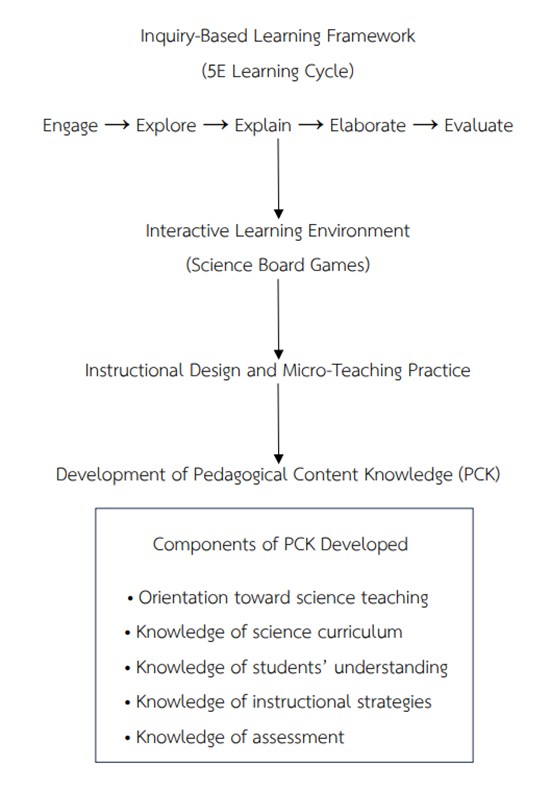
This study aimed to examine the Pedagogical Content Knowledge and perspectives of second-year elementary student teachers through the implementation of the 5E learning cycle integrated with science board games. This qualitative study examined the Pedagogical Content Knowledge (PCK) and perspectives of 30 second-year elementary student teachers. The participants were enrolled in a Learning Management in Science for Elementary School Teachers course at a Thai university. They collaboratively designed inquiry-based lesson plans and implemented them through micro-teaching sessions. Data were collected via lesson documents, observations, reflective journals, and interviews. The analysis was guided by Magnusson et al.’s (1999) PCK framework using interpretive induction. Qualitative data were analyzed using interpretive inductive analysis, while quantitative data from the questionnaire were analyzed using descriptive statistics, including mean and standard deviation. The findings revealed that the student teachers demonstrated emerging Pedagogical Content Knowledge across all five components. The integration of the 5E learning cycle and science board games supported inquiry-based learning, collaborative interaction, and active student engagement. In addition, the participants reported highly positive perspectives toward the instructional approach (M = 4.62, S.D. = 0.57), particularly regarding instructional design and learner-centered learning. The study suggests that integrating inquiry-based learning models with science board games provides meaningful opportunities for developing student teachers’ Pedagogical Content Knowledge and fostering innovative science teaching practices in elementary education.
Article Details

อนุญาตภายใต้เงื่อนไข Creative Commons Attribution-NonCommercial-NoDerivatives 4.0 International License.
เอกสารอ้างอิง
Bybee, R. W. (2013). The case for STEM education: Challenges and opportunities. Arlington, VA: NSTA Press.
Bybee, R. W., Taylor, J. A., Gardner, A., Van Scotter, P., Powell, J. C., Westbrook, A., & Landes, N. (2006). The BSCS 5E Instructional Model: Origins, Effectiveness, and Applications. Colorado: Colorado Springs BSCS.
Duran, L. B., & Duran, E. (2019). The 5E instructional model: A learning cycle approach for inquiry-based science teaching. Science Education International, 30(4), 332–339.
Gess-Newsome, J. (2015). A model of teacher professional knowledge and skill including PCK: Results of the thinking from the PCK Summit. In A. Berry, P. Friedrichsen, & J. Loughran (Eds.), Re-examining pedagogical content knowledge in science education (pp. 28–42). New York: Routledge.
Kind, V. (2019). Pedagogical content knowledge in science education: Perspectives and potential for progress. Studies in Science Education, 55(2), 153–182.
Kolb, D. A. (1984). Experiential learning: Experience as the source of learning and development. Englewood Cliffs, NJ: Prentice-Hall.
Magnusson, S., Krajcik, J., & Borko, H. (1999). Nature, sources, and development of pedagogical content knowledge for science teaching. In J. Gess-Newsome & N. G. Lederman (Eds.), Examining pedagogical content knowledge: The construct and its implications for science education (pp. 95–132). Dordrecht, Netherlands: Kluwer Academic Publishers.
Nilsson, P., & Karlsson, G. (2019). Capturing PCK development during teacher education. International Journal of Science Education, 41(3), 350–371.
OECD. (2019). PISA 2018 results (Volume I): What students know and can do. Paris, France: OECD Publishing.
Park, S., & Chen, Y. C. (2019). Mapping out the integration of the components of pedagogical content knowledge (PCK): Examples from high school biology classrooms. Journal of Research in Science Teaching, 56(7), 1028–1056.
Plass, J. L., Homer, B. D., & Kinzer, C. K. (2015). Foundations of game-based learning. Educational Psychologist, 50(4), 258–283.
Shulman, L. S. (1986). Those who understand: Knowledge growth in teaching. Educational Researcher, 15(2), 4–14.
Tokac, U., Novak, E., & Thompson, C. G. (2019). Effects of game‐based learning on students’ mathematics achievement: A meta-analysis. Journal of Computer Assisted Learning, 35(3), 407–420.
