Intercultural Teaching Competency of Foreign Language Teachers at a Private University in Guangxi, China: A Needs Assessment Perspective on Structural Characteristics
Article Sidebar
Main Article Content
บทคัดย่อ
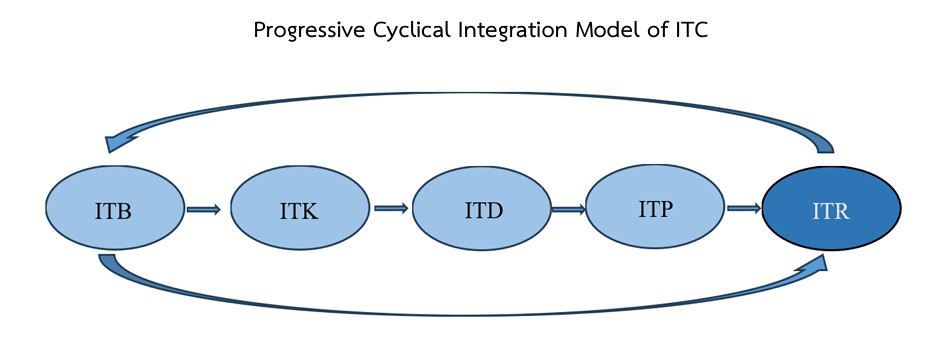
This study aimed to investigate the discrepancy between foreign language teachers’ current and desired levels of intercultural teaching competency (ITC), as well as to identify the structural relationships among its dimensions from a needs assessment perspective. Adopting a quantitative research design, data were collected from 138 foreign language teachers at a private university in Guangxi, China, of whom 136 valid responses were included. A structured questionnaire was used to measure both the perceived current and desired levels of ITC. The data were analyzed using descriptive statistics, paired-sample t-tests, the Modified Priority Needs Index (PNI Modified), and Pearson correlation analysis. The result of the study found that: 1) Teachers' overall ITC was at a medium level (M=3.34, S.D.=0.49), with both current and desired gaps across dimensions being high level. The largest gap was observed in intercultural teaching reflection (ITR) (PNI Modified=0.467). 2) Significant positive correlations were found among all five dimensions of ITC. In particular, intercultural teaching reflection (ITR) demonstrated strong associations with intercultural teaching knowledge (ITK) (r = .810) and intercultural teaching practice (ITP) (r = .802), suggesting a central and integrative role of reflective competence within the overall structure. 3) Based on gap prioritization and structural relationship analysis, the study constructs a “Progressive Cyclical Integration Model of ITC”, emphasizing the dynamic and cyclical interactions among Intercultural Teaching Beliefs (ITB), Intercultural Teaching Knowledge (ITK), Intercultural Teaching Design (ITD), Intercultural Teaching Practice (ITP), and Intercultural Teaching Reflection (ITR), with ITR playing a central integrative role.
Article Details

อนุญาตภายใต้เงื่อนไข Creative Commons Attribution-NonCommercial-NoDerivatives 4.0 International License.
เอกสารอ้างอิง
ACTFL. (1996). Standards for Foreign Language Learning: Preparing for the 21st Century. Alexandria, VA: ACTFL.
Aekwut, K., Julsuwan, S., & Chansirisira, P. (2025). Needs Assessment for Enhancing Teacher Leadership among Teachers in Small Primary Schools under the Office of Basic Education Commission. Journal of Education and Learning, 14(4), 262-269.
Altschuld, J. W., & Kumar, D. D. (2010). Needs Assessment KIT: Needs Assessment: An Overview. Thousand Oaks, California: SAGE Publications.
Boone Jr, H. N., & Boone, D. A. (2012). Analyzing likert data. The Journal of extension, 50(2), 48.
Byram, M. (1997). Teaching and assessing intercultural communicative competence. Bristol: Multilingual Matters.
Byram, M. (2009). Intercultural Competence in Foreign Languages: The Intercultural Speaker and the Pedagogy of Foreign Language Education. In The SAGE Handbook of Intercultural Competence (pp. 321-332). Thousand Oaks, California: SAGE Publications.
Council of Europe (CEFR) (2001). Common European Framework of Reference for Languages Learning, Teaching, Assessment. Cambridge: Cambridge University Press.
Deardorff, D. K. (2006). Identification and assessment of intercultural competence as a student outcome of internationalization. Journal of studies in international education, 10(3), 241-266.
Faez, F., Yang, Y., & Karas, M. (2025). Exploring the Relationship between Reflective Practice and Language Teachers' Self-Efficacy Beliefs (2010-2024): A Systematic Review. TESL-EJ, 29(2), n2.
George, D., & Mallery, P. (2010). SPSS for Windows Step by Step: A Simple Guide and Reference. Upper Saddle River, New Jersey: Prentice Hall Press.
Jiang, Q., Soon, S., & Li, Y. (2021). Enhancing Teachers' Intercultural Competence with Online Technology as Cognitive Tools: A Literature Review. English Language Teaching, 14(3), 1-11.
Lallana, A., & Salamanca, P. (2020). Intercultural communicative competence in L2 Spanish: guidelines for teacher training programmes. Journal of Spanish Language Teaching, 7(2), 178-192.
Li, H., Zhang, Y., & Hu, M. (2021). Multi-regional cooperation BRI and Guangxi. In China’s Belt and Road Initiative (pp. 149-170). Oxfordshire: Routledge.
Liddicoat, A. J., & Scarino, A. (2013). Intercultural language teaching and learning. Hoboken, New Jersey: John Wiley & Sons.
Ministry of Education of the People's Republic of China. (2000). Teaching Syllabus for English Majors in Colleges and Universities. Beijing: Foreign Language Teaching and Research Press.
Ministry of Education of the People's Republic of China. (2010). National Medium- and Long-Term Education Reform and Development Plan (2010–2020). Beijing: Ministry of Education.
Ministry of Education of the People's Republic of China. (2018). National Quality Standards for Foreign Languages Undergraduate Education. Beijing: Ministry of Education.
Schön, D. A. (1992). The reflective practitioner: How professionals think in action. London: Routledge.
Sercu, L. (2005). Foreign language teachers and the implementation of intercultural education: a comparative investigation of the professional self‐concepts and teaching practices of Belgian teachers of English, French and German. European journal of teacher education, 28(1), 87-105.
Tajeddin, Z., Saeedi, Z., & Khanlarzadeh, N. (2024). Enhancing language teachers’ skills for intercultural instruction: affordance of collaborative reflection. Language and Intercultural Communication, 24(6), 693-709.
Tolosa, C., Biebricher, C., East, M., & Howard, J. (2018). Intercultural language teaching as a catalyst for teacher inquiry. Teaching and Teacher Education, 70, 227-235.
UNESCO. (2006). Guidelines on Intercultural Education. Retrieved from http://unesdoc.unesco.org/images/0014/001478/147878e.
Wanner, C. A. (2021). Narrowing the Gap: The Mediated Field Experience as a Pedagogy to Identify and Build Coherence Between Mathematics Methods Coursework and Field Experience. (Doctoral dissertation, Middle Tennessee State University).
Zheng, X. (2019). A literature review of the research on intercultural language teachers at home and abroad. Foreign Language World, 4, 85-93.
Zheng, X., & Gao, Y. (2019). Promoting intercultural competence in English language teaching: A productive bilingualism perspective. In Second handbook of English language teaching (pp. 199-219). Cham: Springer International Publishing.
