The Influence of Project-Based Learning on Student Cultural Confidence in Dance Work Creation and Performance Course at a Chengdu University
Article Sidebar
Main Article Content
บทคัดย่อ
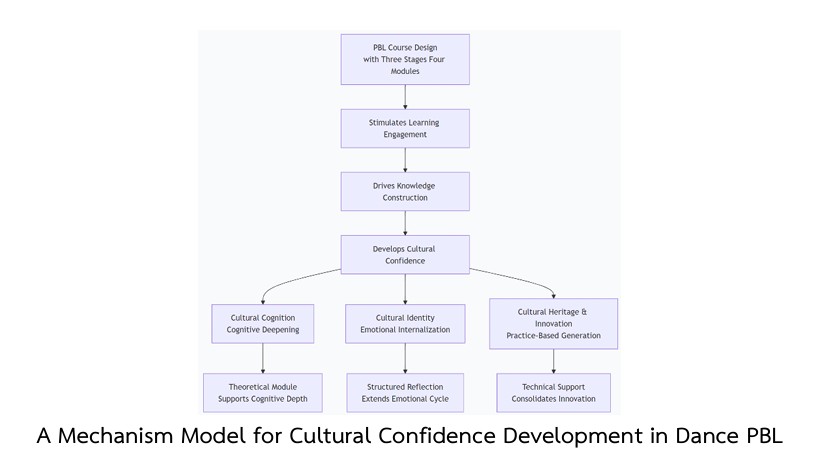
This study explored the influences of Project-based Learning on student cultural confidence in a Dance Work Creation and Performance Course at a Chengdu University. Using a mixed methods research approach, a structured questionnaire was administered to 30 students to quantitatively assess cultural confidence, learning engagement, and knowledge construction. This was supplemented by participant observation and in-depth interviews, with data analyzed via SPSS and NVivo. The result of the study found that: 1) The course significantly enhanced students' Learning Engagement, their Knowledge Construction, and their overall cultural confidence, with the Cultural Heritage and Innovation dimension showing the most significant improvement. 2) Statistical mediation analysis revealed that Learning Engagement and Knowledge Construction sequentially and significantly mediated the relationship between the course intervention and the development of cultural identity. 3) Qualitative data indicated that through the structured learning process, students deepened their understanding and internalization of Chinese excellent traditional culture via collaborative exploration and embodied artistic expression.
Article Details

อนุญาตภายใต้เงื่อนไข Creative Commons Attribution-NonCommercial-NoDerivatives 4.0 International License.
เอกสารอ้างอิง
Buck, R. (2022). Teaching and learning in, about and through dance education. In Dance pedagogy and education in China: A personal narrative of teaching in, about and through dance education (pp. 19-41). Singapore: Springer Nature Singapore.
Evans, C. M., & Taylor, C. S. (2025). Culturally responsive assessment in classrooms and large-scale contexts: Theory, research, and practice. New York: Routledge.
Fredricks, J. A., Blumenfeld, P. C., & Paris, A. H. (2004). School engagement: Potential of the concept, state of the evidence. Review of educational research, 74(1), 59-109.
Jacobs, R. (2023). Affective and Emotional Experiences in Arts-Based Service-Learning Environments. International Journal of Emotional Education, 15(1), 4-20.
Kaiser, F. G., & Wilson, M. (2019). The Campbell paradigm as a behavior-predictive reinterpretation of the classical tripartite model of attitudes. European Psychologist, 24(4), 359–374.
Loyens, S. M., Van Meerten, J. E., Schaap, L., & Wijnia, L. (2023). Situating higher-order, critical, and critical-analytic thinking in problem-and project-based learning environments: A systematic review. Educational Psychology Review, 35(2), 39.
Malarsih, M., Haryono, S., & Widodo, W. (2025). Local Culture–Based Dance Learning with the Integration of Students’ Creativity, Motor Skills, and Social Sensitivity. Catharsis, 14(2), 147-154.
Martins, J., Cunha, J., Lopes, S., Moreira, T., & Rosário, P. (2022). School engagement in elementary school: A systematic review of 35 years of research. Educational psychology review, 34(2), 793-849.
Phinney, J. S. (1990). Ethnic identity in adolescents and adults: A review of research. Psychological Bulletin, 108, 499-514.
Rahman, L. (2024). Vygotsky’s zone of proximal development of teaching and learning in STEM education. International Journal of Engineering Research & Technology, 13(8), 389-94.
Saltsman, E. (2025). Using habitus and ethnic identity theory to investigate the decision-making of Canadian Modern Orthodox young people. Research Papers in Education, 40(4), 495-514.
Sánchez-García, R., & Reyes-de-Cózar, S. (2025). Enhancing project-based learning: A framework for optimizing structural design and implementation—A systematic review with a sustainable focus. Sustainability, 17(11), 4978.
Schupp, K. (2024). Rethinking the pedagogy of dance pedagogy. Research in Dance Education, 25(3), 254-267.
Shaff, J., Atkin, A. L., Kahn, G., & Wilcox, H. C. (2024). Examination of the psychometric properties of the Ethnic Identity Scale (EIS) and Multicultural Identity Integration Scale (MULTIIS) in a multiracial population in the United States. Journal of counseling psychology, 71(6), 596.
Shaw, J. T. (2022). Culturally responsive, relevant, and sustaining pedagogies. The Choral Journal, 63(3), 51-60.
Shih, Y. H. (2024). Culturally responsive curriculum: A systematic overview. Edelweiss Applied Science and Technology, 8(6), 6917-6925.
Silma, N., Maulida, I., Wulan, A. P., Merawati, J., & Hasan, M. K. (2024). A comprehensive review of Project-Based Learning (PBL): Unravelling its aims, methodologies, and implications. Journal of Education, Social & Communication Studies, 1(1), 10-19.
Thomas, J. W. (2000). A review of research on project-based learning. Retrieved from https://tecfa.unige.ch/proj/eteach-net/Thomas_researchreview_PBL.pdf.
Ting, Z., & Chongzeng, B. (2023). Does the regional multicultural experience weaken the cultural confidence in hometown? The compensatory role of cultural attachment. Journal of Psychological Science, 46(5), 1131-1140.
Totin, E., Thompson-Hall, M., Roncoli, C., Sidibé, A., Olabisi, L. S., & Zougmoré, R. B. (2021). Achieving sustainable future objectives under uncertain conditions: Application of a learning framework to adaptation pathways in rural Mali. Environmental Science & Policy, 116, 196-203.
Yamo, P., Kim, S., & Dreamson, N. (2022). Cultural engagement as a pedagogical system: thai learners’ engagement in online learning environments. Multicultural Education Review, 14(1), 48-63.
Yusri, R., Yusof, A. M., & Sharina, A. (2024). A systematic literature review of project-based learning: research trends, methods, elements, and frameworks. International Journal of Evaluation and Research in Education, 13(5), 3345-3359.
Zeng, Y., Isleem, H. F., Tejani, G. G., Jahami, A., & Alnowibet, K. A. (2025). Examining the impact of culturally responsive teaching and identity affirmation on student outcomes: A mixed-methods study in diverse educational settings. International Journal of Educational Development, 117, 103376.
Zhang, L., & Ma, Y. (2023). A study of the impact of project-based learning on student learning effects: A meta-analysis study. Frontiers in psychology, 14, 1202728.
