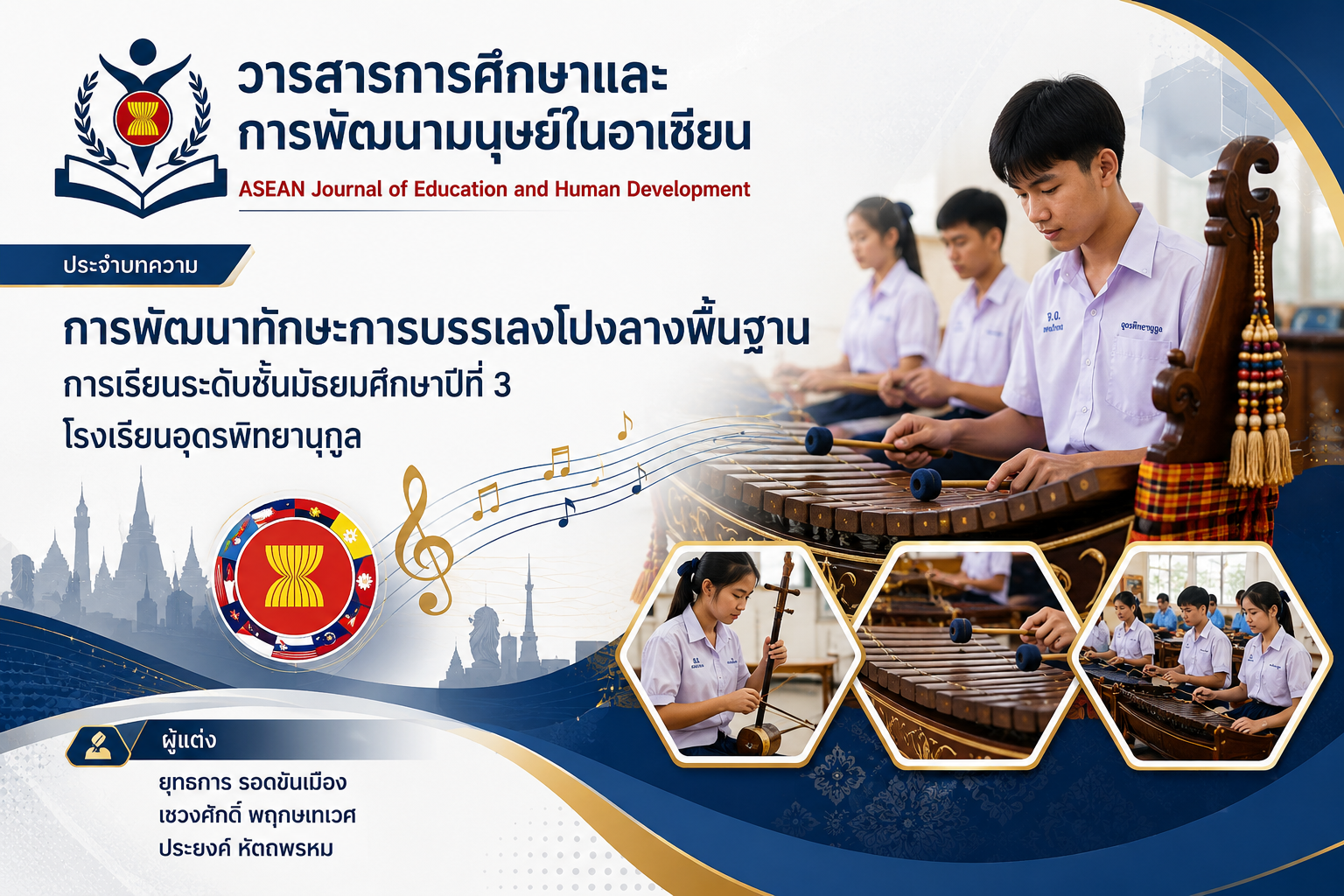
THE DEVELOPMENT OF BASIC PONG LANG PERFORMANCE SKILLS OF GRADE 9 STUDENTS AT UDONPITTAYANUKOON SCHOOL
Keywords:
Ponglang Performance Skills, Practical Learning, Northeastern Thai Folk Music, PONGLANG-5P ModelAbstract
This research aimed to: 1) develop the basic Ponglang playing skills of Grade 9 students at Udonpittayanukoon School, 2) compare students’ Ponglang playing skills before and after participating in practical learning activities, and 3) investigate students’ learning behaviors following the implementation of the activities. The sample consisted of 14 Grade 9 students from Class 3/8 during the second semester of the 2025 academic year, selected through purposive sampling. The research instruments included practical learning lesson plans, a basic Ponglang performance skills assessment form, and a learning behavior observation form. Data were analyzed using mean, standard deviation, percentage, and dependent samples t-test.
The findings revealed that: 1) students’ basic Ponglang playing skills after the intervention were significantly higher than those before the intervention at the .05 level; 2) most students passed the predetermined criterion, accounting for 85.71 percent, and their overall Ponglang performance skills were rated at a very good level; and 3) students demonstrated increased interest and enthusiasm in learning, showed greater responsibility in practicing, were able to collaborate effectively with peers, and developed a stronger sense of pride in Northeastern Thai folk music. Furthermore, the researcher synthesized a new body of knowledge entitled the PONGLANG-5P Model, which consists of Practice-Based Learning, Observation and Demonstration, Network Collaboration, Guided Feedback, and Local Art and New Generation. This model serves as an effective approach for enhancing Ponglang performance skills while promoting the preservation and sustainable transmission of Northeastern Thai folk music heritage.
References
ณรุทธ์ สุทธจิตต์. (2562). ดนตรีศึกษา: หลักการและสาระสำคัญ. กรุงเทพฯ: สำนักพิมพ์แห่งจุฬาลงกรณ์มหาวิทยาลัย.
ภัสรญานันท์ ดิลกจิรธนกิตติ์, และ สุทธิรักษ์ เอียดปุ่ม (2568). การสร้างแบบฝึกการพัฒนาโสตทักษะทางดนตรีจากบทเพลงรองเง็งสำหรับนักเรียนของเดอะเปียโนมิวสิคสตูดิโอ อำเภอเกาะสมุย จังหวัดสุราษฎร์ธานี. วารสารครุศาสตร์ปัญญา, 4(3), 1–14.
พิมพันธ์ เดชะคุปต์, และ พเยาว์ ยินดีสุข. (2566). Active Learning เพื่อพัฒนาสมรรถนะผู้เรียน. กรุงเทพฯ: สำนักพิมพ์แห่งจุฬาลงกรณ์มหาวิทยาลัย.
ภิภพ ปิ่นแก้ว. (2559). การปฏิบัติโปงลาง. อุดรธานี: มหาวิทยาลัยราชภัฏอุดรธานี.
ประชุมวรรณ กัลยา, มูลเมืองแสน ธนพงศ์, ดวงรัตน์ สุพัตรา, และ พิมพ์ศักดิ์ นฤมล. (2568). การพัฒนาระบบการสอนทักษะปฏิบัติดนตรีในระบบการศึกษาโดยใช้กระบวนการสอนแบบผู้ชี้นำและการคิดสร้างสรรค์. วารสารมนุษยศาสตร์และสังคมศาสตร์ มหาวิทยาลัยราชภัฏอุบลราชธานี, 16(2), 196–212.
เบญจมาศ พิกุลทอง, รัชชานนท์ มีเดช, และ แมน เชื้อบางแก้ว. (2569). การพัฒนาผลสัมฤทธิ์ทางการเรียนดนตรีของผู้เรียนชั้นประถมศึกษาปีที่ 4 โดยใช้การจัดการเรียนรู้ที่เน้นกระบวนการปฏิบัติร่วมกับแนวคิดของซูซูกิ. วารสารสังคมพัฒนศาสตร์, 9(3), 250–259.
อรรถพล อย่างสวย, และ ดุจเดือน ไชยพิชิต. (2565). การพัฒนาทักษะการปฏิบัติเมโลเดียนสำหรับนักเรียนชั้นประถมศึกษาปีที่ 4–6 ด้วยการจัดการเรียนรู้แบบทางตรงร่วมกับเทคนิค STAD. วารสาร มจร อุบลปริทรรศน์, 7(3), 1001–1014.
อุทาน บุญเมือง. (2569). การพัฒนาชุดฝึกทักษะการบรรเลงตะโพนไทยเบื้องต้นสำหรับนักศึกษาชั้นปีที่ 1 สาขาดนตรีและนาฏศิลป์ศึกษา คณะครุศาสตร์ มหาวิทยาลัยราชภัฏพิบูลสงคราม. Journal of Applied Education, 4(1), 45–58.
Kolb, D. A. (1984). Experiential Learning: Experience as the Source of Learning and Development. Englewood Cliffs, NJ: Prentice-Hall.
Downloads
Published
How to Cite
Issue
Section
License
Copyright (c) 2026 ASEAN Journal of Education and Human Development

This work is licensed under a Creative Commons Attribution-NonCommercial-NoDerivatives 4.0 International License.
Articles in this journal are copyrighted by the x may be read and used for academic purposes, such as teaching, research, or citation, with proper credit given to the author and the journal.use or modification of the articles is prohibited without permission.
statements expressed in the articles are solely the opinions of the authors.
authors are fully responsible for the content and accuracy of their articles.
other reuse or republication requires permission from the journal."