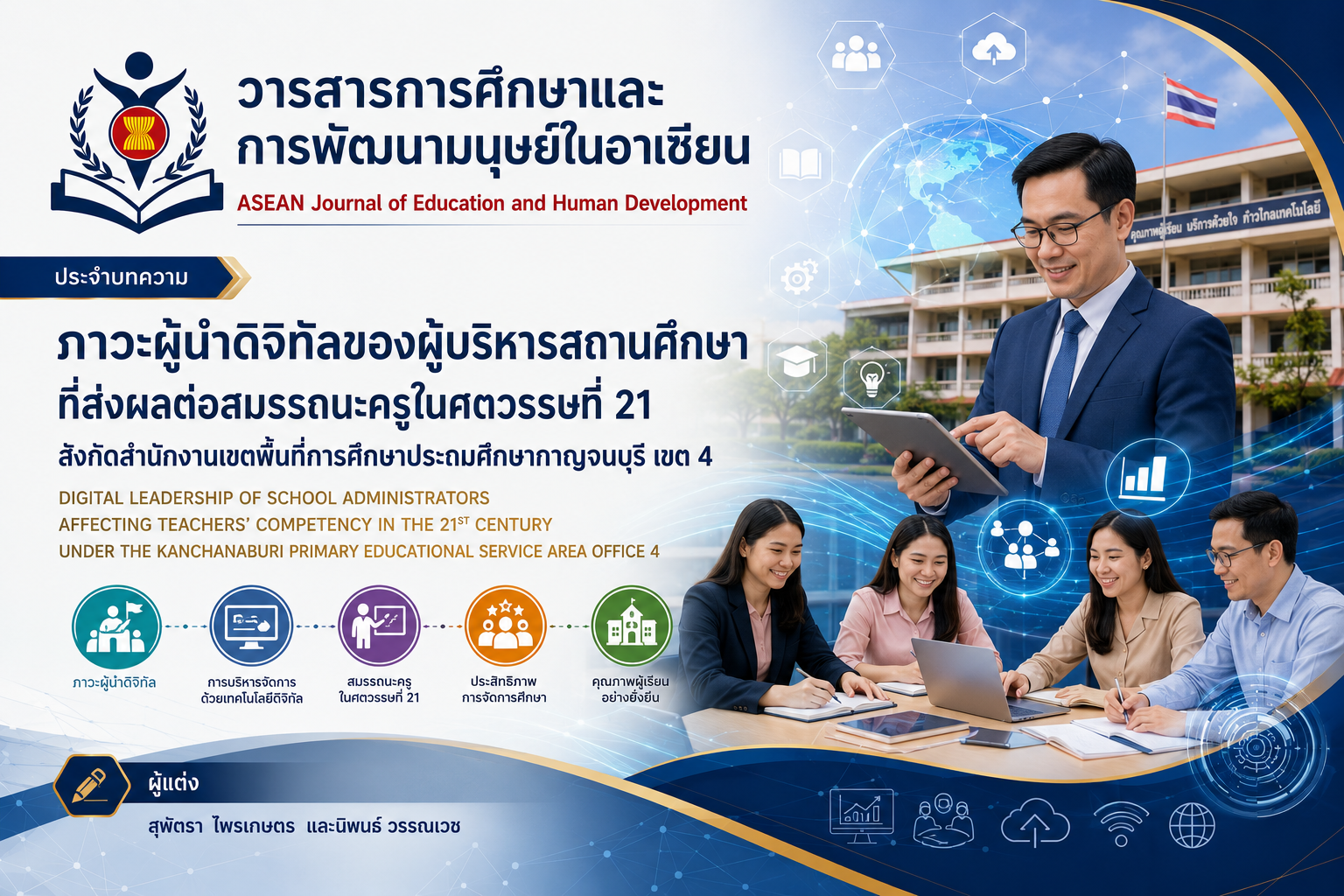
DIGITAL LEADERSHIP OF SCHOOL ADMINISTRATORS AFFECTING TEACHERS’ COMPETENCY IN THE 21ST CENTURY UNDER THE KANCHANABURI PRIMARY EDUCATIONAL SERVICE AREA OFFICE 4
Keywords:
Digital Leadership, 21st Century Teacher Competencies, School AdministratorsAbstract
The purposes of this research were to 1) study the digital leadership of school administrators, 2) the 21st century teacher competencies, and 3) the digital leadership of school administrators affecting the 21st century teacher competencies under Kanchanaburi Primary Educational Service Area Office 4.
The sample used in this study consisted of 281 school administrators and teachers. The sample was selected by stratified sampling based on educational management areas. The research instrument was a five-rating scale questionnaire. The questionnaire consisted of 41 items with an Index of Item-Objective Congruence (IOC) of 1.00. The reliability coefficient was 0.96. The statistics used for data analysis were percentage, mean, standard deviation, and simple regression analysis. The statistical significance level was set at 0.01.
The findings were as follows: 1) The digital leadership of school administrators, as a whole, was at the highest level. When considering each aspect, all aspects were also at the highest level. Ranked by mean scores, the highest was digital learning culture, followed by excellence in professional practice, and digital vision. 2) The 21st century teacher competencies, as a whole, were at the highest level. When considering each aspect, all aspects were also at the highest level. Ranked by mean scores, the highest was teamwork, followed by ethics, self-development, and learning management. 3) The digital leadership of school administrators affecting the 21st century teacher competencies, as a whole, had a regression coefficient of 0.74 with statistical significance at the 0.01 level. The coefficient of determination (R²) was 0.69, indicating that digital leadership could predict 43.10 percent of the variance in 21st century teacher competencies. The regression equations were as follows: = 1.29 + 0.74X Y = 0.83ZX
References
Altinay, F. (2015). Are headmasters digital leaders in school culture. Education and Science, 40(182), 77–86.
Anderson, R. E., & Dexter, S. (2005). School technology leadership: An empirical investigation of prevalence and effect. Educational Administration Quarterly, 41(1), 49–82.
Battele for kids. (2019). Framework for 21st century learning definitions. Retrieved from https://www.battelleforkids.org/wpcontent/uploads/2023/11
Bureau of Teacher and Basic Education Personnel Development. (2010). Teacher competency assessment manual (Revised edition): Teacher Quality Improvement Project for the Whole System. Bangkok, Thailand: Author.
Chantharasuk, J., & Watcharakul, J. (2021). A study of the components of digital leadership for administrators of educational opportunity expansion schools under Udon Thani Primary Educational Service Area Office 3. Academic Journal of Sisaket Rajabhat University, 15(2), 36–49. https://so05.tci-haijo.org/index.php/sskrujournal/article/view/251332
Office of the National Strategy Committee Secretariat. (2018). The National Strategy 2018–2037 (Summary Version). Bangkok, Thailand: Author.
Office of the Education Council. (2017). National Education Plan 2017–2036. Bangkok, Thailand: Prikwan Graphic Co., Ltd.
Sheninger, E. C. (2014). Digital leadership: changing paradigms for changing times. United States: Corwin.
Thannimalai & Raman. (2018). Principals' technology leadership and teachers' technology integration in the 21st century classroom. Retrieved from https://iaeme.com/MasterAdmin/Journal_uploads/IJCIET
Trilling, B., & Fadel, C. (2009). 21st century skills: Learning for life times. Jossey-Bass.
Voogt, J., & Roblin, N. P. (2012). A comparative analysis of international frameworks for 21st century competences: Implications for national curriculum policies. Journal of Curriculum Studies, 44(3), 299–321. https://doi.org/10.1080/00220272.2012.668938
Downloads
Published
How to Cite
Issue
Section
License
Copyright (c) 2026 ASEAN Journal of Education and Human Development

This work is licensed under a Creative Commons Attribution-NonCommercial-NoDerivatives 4.0 International License.
Articles in this journal are copyrighted by the x may be read and used for academic purposes, such as teaching, research, or citation, with proper credit given to the author and the journal.use or modification of the articles is prohibited without permission.
statements expressed in the articles are solely the opinions of the authors.
authors are fully responsible for the content and accuracy of their articles.
other reuse or republication requires permission from the journal."