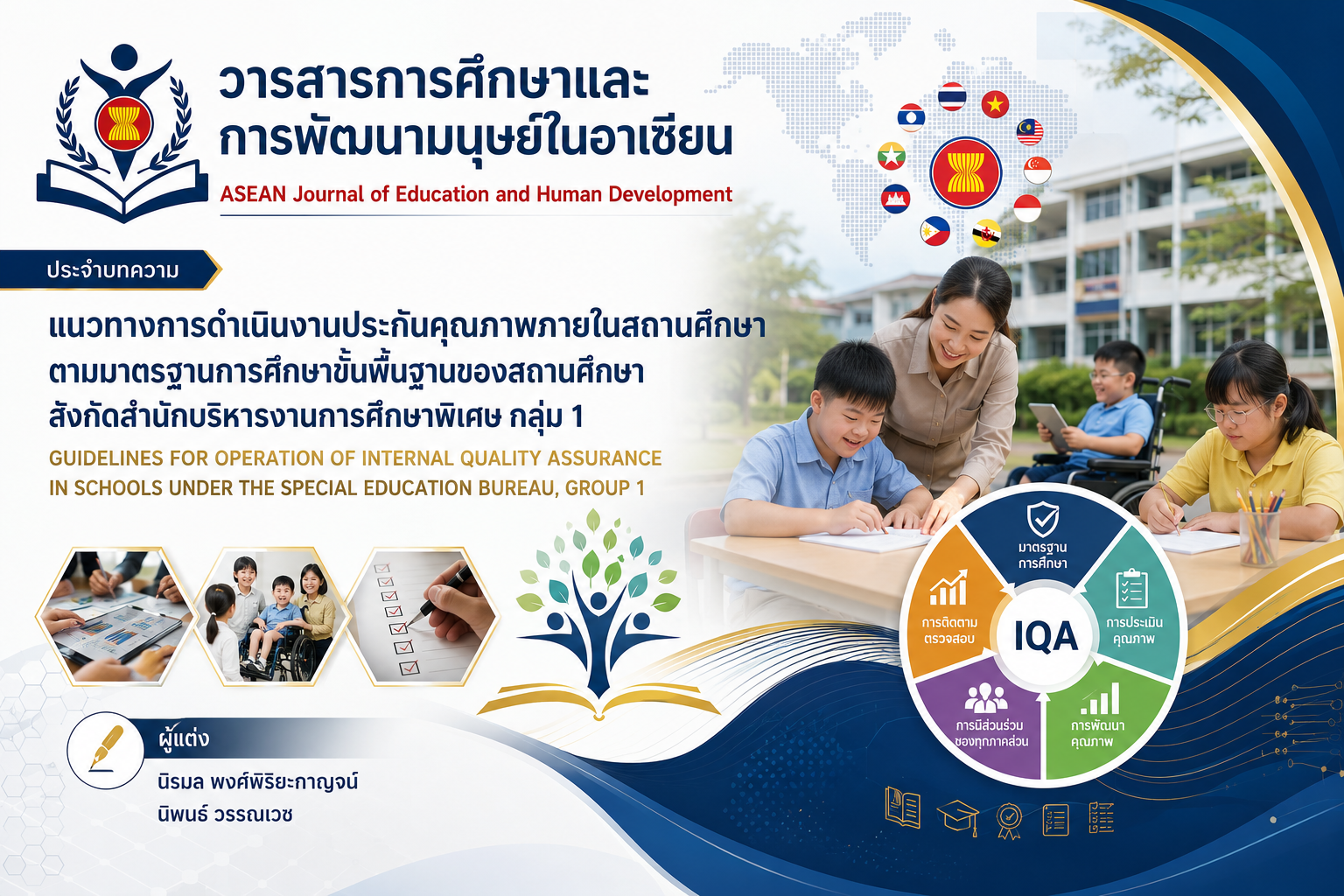
GUIDELINES FOR OPERATION OF INTERNAL QUALITY ASSURANCE IN SCHOOLS UNDER THE SPECIAL EDUCATION BUREAU, GROUP 1
Keywords:
Internal Quality Assurance in Educational Institutions, Basic Education Standards, Special Education Administration BureauAbstract
This research aimed to 1) study the safety management and 2) guidelines for operation of internal quality assurance in schools under the special education bureau group 1. The sample of this research consisted of 211 school administrators and teachers from welfare schools under the administration of the Special Education Bureau, Group 1. The samples were selected by simple random sampling. In addition, eight key informants were purposively selected for the focus group discussion. The research instrument was a five-level rating scale questionnaire with a content validity index of 1.00 and a reliability coefficient of 0.97 The statistics used for data analysis were percentage, mean, standard deviation, and content analysis.
The findings were as follows: 1) The implementation of internal quality assurance in educational institutions based on the Basic Education Standards under Special Education Administration Cluster 1 was found, both overall and in each aspect, to be at the highest level of practice. The aspects ranked from the highest to the lowest mean scores were as follows: learner quality, learner-centered instructional management process, and administrative and management process, respectively. 2) The guidelines for implementing internal quality assurance in educational institutions based on the Basic Education Standards are as follows: 1) Learner Quality: Learners should possess desirable characteristics in accordance with the educational institution’s goals and demonstrate appropriate abilities in reading, writing, numeracy, and communication corresponding to their grade level. 2) Administrative and Management Processes: Educational institutions should establish clear goals, vision, mission, and educational development plans that are aligned with the context and needs of the institution. And 3) Student-Centered Teaching and Learning Processes: Teachers should organize learning activities that emphasize hands-on experiences, promote analytical thinking and problem-solving skills, and enable learners to construct knowledge by themselves.
References
Department of Special Education. (2022). Summary report on the implementation of internal quality assurance in educational institutions under its jurisdiction for the fiscal year 2022. Bangkok: Ministry of Education.
Drucker, P. F. (2007). Management challenges for the 21st century. Butterworth-Heinemann.
Educational Testing Service Bureau. (2018). Guidelines for internal quality assurance at the basic education level B.E. 2561 (2018). Bangkok: Office of the Basic Education Commission.
Fullan, M. (2016). The new meaning of educational change (5th ed.). Teachers College Press.
Krejcie, R. V., & Morgan, D. W. (1970). Determining sample size for research activities. Educational and Psychological Measurement, 30(3), 607-610.
Kahl, K. A. (2015). Principals’ criteria for quality middle school instruction (teacher Supervision reform). Dissertation Abstracts International, 58(11), 6039-A. https://www.proquest.com/products-services/dissertations
Martin, M. (2018). Internal quality assurance and management: How to close the loop between evidence and decision-making. UNESCO International Institute for Educational Planning (IIEP).
Ministry of Education. (2018). Basic education standards B.E. 2561 (2018). Bangkok: Office of the Permanent Secretary, Ministry of Education.
Office of the Basic Education Commission. (2005). Ministerial Regulation on Educational Quality Assurance B.E. 2561 (2018). Volume 135, Special Issue 142 Ng.
Sallis, E. (2014). Total quality management in education (3rd ed.). Routledge.
United Nations Educational, Scientific and Cultural Organization. (2024). Global education monitoring report 2024. UNESCO. https://www.unesco.org/gem-report/
Vanhoof, J., & Van Petegem, P. (2010). Evaluating the quality of self-evaluations: The (mis)match between internal and external meta-evaluation. Studies in Educational Evaluation, 36(1–2), 20–26. https://doi.org/10.1016/j.stueduc.2010.10.001
Downloads
Published
How to Cite
Issue
Section
License
Copyright (c) 2026 ASEAN Journal of Education and Human Development

This work is licensed under a Creative Commons Attribution-NonCommercial-NoDerivatives 4.0 International License.
Articles in this journal are copyrighted by the x may be read and used for academic purposes, such as teaching, research, or citation, with proper credit given to the author and the journal.use or modification of the articles is prohibited without permission.
statements expressed in the articles are solely the opinions of the authors.
authors are fully responsible for the content and accuracy of their articles.
other reuse or republication requires permission from the journal."