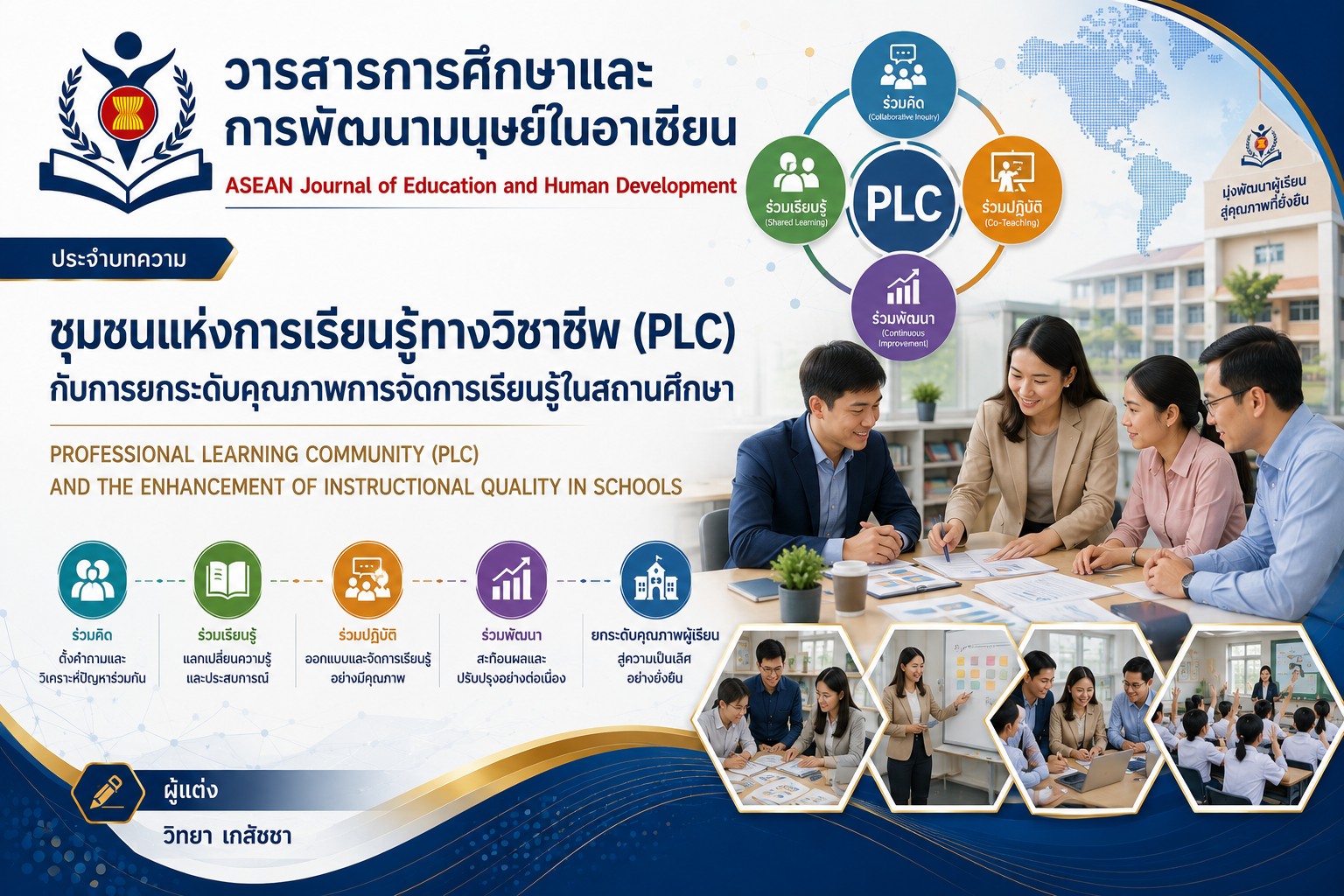
PROFESSIONAL LEARNING COMMUNITY (PLC) AND THE ENHANCEMENT OF INSTRUCTIONAL QUALITY IN SCHOOLS
Keywords:
Professional Learning Community, Teacher development, Quality of teaching and learning, Professional Learning Community, teacher development, quality of teaching and learning, school improvementAbstract
This academic article aims to present the concepts, principles, and implementation approaches of Professional Learning Communities (PLC) in enhancing the quality of teaching and learning in schools. The article discusses the definition, key components, operational processes, and outcomes of PLC implementation in educational contexts. It highlights that PLC serves as an essential mechanism for promoting teacher collaboration, professional competency development, instructional innovation, and continuous improvement in teaching practices, which subsequently contribute to students’ academic achievement, learning atmosphere, and overall school quality. Furthermore, the article proposes practical guidelines for applying PLC in schools, including organizational models, meeting structures and schedules, teacher motivation strategies, the use of digital technologies to support collaboration, and critical success factors. The synthesis of the content indicates that systematic and sustained PLC implementation can strengthen educational organizations and support the sustainable development of learning quality in response to the demands of twenty-first-century education.
References
สำนักงานคณะกรรมการการศึกษาขั้นพื้นฐาน. (2562). แนวทางการดำเนินงานชุมชนแห่งการเรียนรู้ทางวิชาชีพ (Professional Learning Community: PLC). กรุงเทพฯ:กระทรวงศึกษาธิการ.
Darling-Hammond, L., Hyler, M. E., & Gardner, M. (2017). Effective teacher professional development. Learning Policy Institute.
DuFour, R., Eaker, R., & Many, T. (2010). Learning by doing: A handbook for professional learning communities at work (2nd ed.). Solution Tree Press.
Fullan, M. (2016). The new meaning of educational change (5th ed.). Teachers College Press.
Hargreaves, A., & O’Connor, M. T. (2018). Collaborative professionalism: When teaching together means learning for all. Corwin Press.
Hord, S. M. (1997). Professional learning communities: Communities of continuous inquiry and improvement. Southwest Educational Development Laboratory.
Leithwood, K., Harris, A., & Hopkins, D. (2020). Seven strong claims about successful school leadership revisited. School Leadership & Management, 40(1), 5–22.
Organisation for Economic Co-operation and Development. (2019). OECD learning compass 2030: A series of concept notes. OECD Publishing. https://www.oecd.org/education/2030-project/
Senge, P. M. (2006). The fifth discipline: The art and practice of the learning organization (Rev. ed.). Doubleday.
Stoll, L., Bolam, R., McMahon, A., Wallace, M., & Thomas, S. (2006). Professional learning communities: A review of the literature. Journal of Educational Change, 7(4), 221–258.
Downloads
Published
How to Cite
Issue
Section
License
Copyright (c) 2026 ASEAN Journal of Education and Human Development

This work is licensed under a Creative Commons Attribution-NonCommercial-NoDerivatives 4.0 International License.
Articles in this journal are copyrighted by the x may be read and used for academic purposes, such as teaching, research, or citation, with proper credit given to the author and the journal.use or modification of the articles is prohibited without permission.
statements expressed in the articles are solely the opinions of the authors.
authors are fully responsible for the content and accuracy of their articles.
other reuse or republication requires permission from the journal."