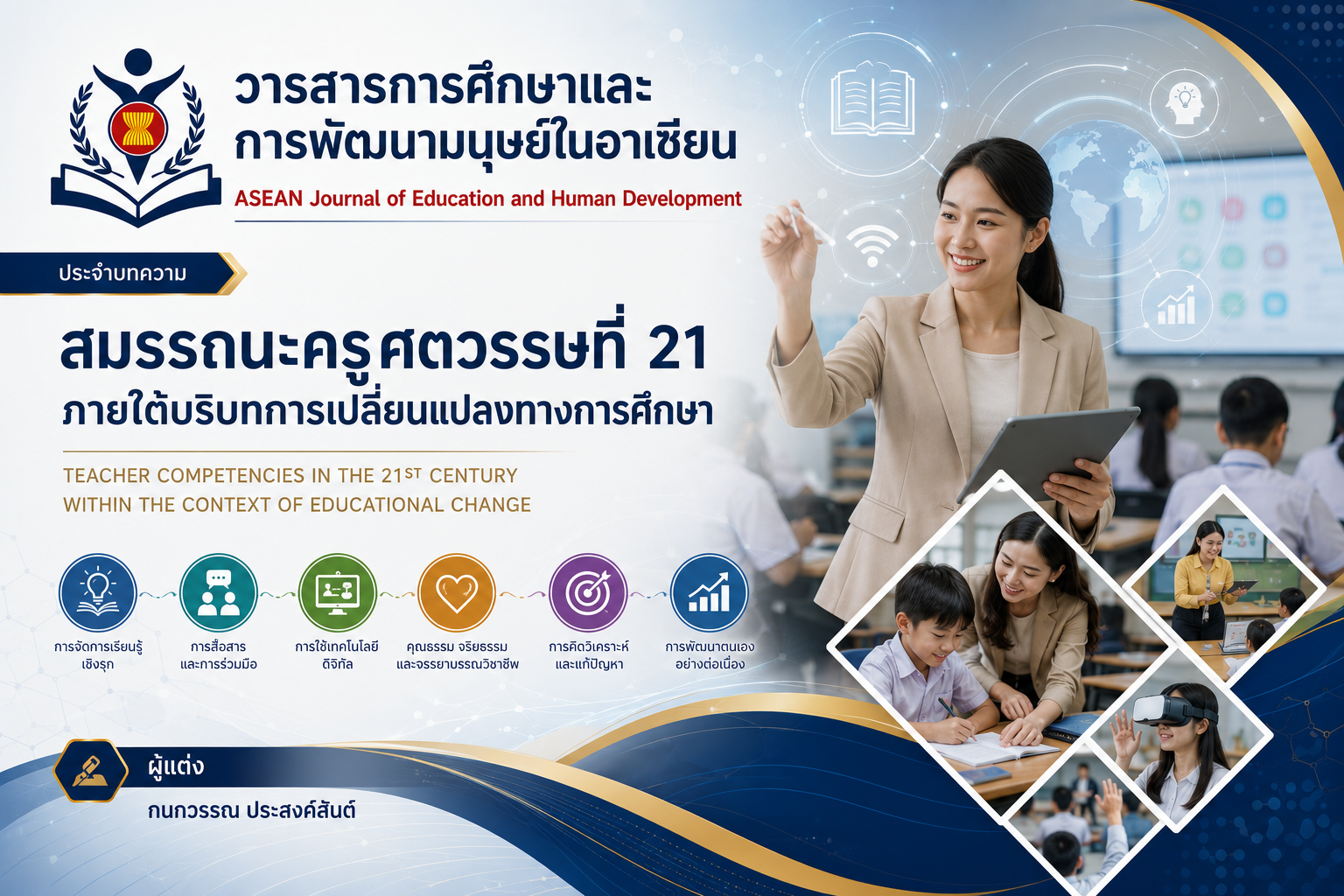
TEACHER COMPETENCIES IN THE 21ST CENTURY WITHIN THE CONTEXT OF EDUCATIONAL CHANGE
Keywords:
Teacher competency, 21st century, educational change, professional developmentAbstract
Education in the 21st century faces significant changes in technology, curriculum, learners, and socio-economic and global contexts, which directly impact the roles and competencies required of teachers to facilitate effective learning. This article aims to explore 21st-century teacher competencies and strategies for their development within the context of educational change. Findings indicate that teacher competencies encompass learner-centered instructional design, the use of technology and educational innovation, assessment and evaluation, communication and collaboration, ethics and professionalism, as well as self-development and lifelong learning. Developing these competencies requires a systematic approach through continuous professional development, professional learning communities, integration of technology and innovation, and support from schools and relevant agencies, ultimately enhancing educational quality and responding effectively to the challenges of the 21st century.
References
กระทรวงศึกษาธิการ. (2563). แนวทางการพัฒนาหลักสูตรฐานสมรรถนะ. กรุงเทพฯ: กระทรวงศึกษาธิการ.
คุรุสภา. (2562). มาตรฐานวิชาชีพครู. กรุงเทพฯ: คุรุสภา.
คุรุสภา. (2562). ข้อบังคับคุรุสภาว่าด้วยมาตรฐานวิชาชีพและจรรยาบรรณของวิชาชีพ. กรุงเทพฯ: คุรุสภา.
สำนักงานเลขาธิการสภาการศึกษา. (2564). แนวทางการพัฒนาครูไทยในศตวรรษที่ 21. กรุงเทพฯ: พริกหวานกราฟฟิค.
สำนักงานเลขาธิการสภาการศึกษา. (2564). สมรรถนะครูไทยในศตวรรษที่ 21. กรุงเทพฯ: พริกหวานกราฟฟิค.
______. (2564). ทิศทางการพัฒนาการศึกษาไทยในศตวรรษที่ 21. กรุงเทพฯ: พริกหวานกราฟฟิค.
Black, P., & Wiliam, D. (2009). Developing the theory of formative assessment. Educational Assessment, Evaluation and Accountability, 21(1), 5–31.
Boyatzis, R. E. (1982). The competent manager: A model for effective performance. John Wiley & Sons.
Darling-Hammond, L. (2017). Teacher education around the world: What can we learn from international practice? European Journal of Teacher Education, 40(3), 291–309.
DuFour, R., & Eaker, R. (1998). Professional learning communities at work: Best practices for enhancing student achievement. Solution Tree Press.
McClelland, D. C. (1973). Testing for competence rather than for intelligence. American Psychologist, 28(1), 1–14.
Organisation for Economic Co-operation and Development. (2019). OECD learning compass 2030: Future of education and skills 2030. OECD Publishing.
Partnership for 21st Century Learning. (2019). Framework for 21st century learning. Battelle for Kids.
Prensky, M. (2001). Digital natives, digital immigrants. On the Horizon, 9(5), 1–6.
UNESCO. (2015). Rethinking education: Towards a global common good? UNESCO Publishing.
UNESCO. (2018). ICT competency framework for teachers (Version 3). UNESCO Publishing.
Downloads
Published
How to Cite
Issue
Section
License
Copyright (c) 2026 ASEAN Journal of Education and Human Development

This work is licensed under a Creative Commons Attribution-NonCommercial-NoDerivatives 4.0 International License.
Articles in this journal are copyrighted by the x may be read and used for academic purposes, such as teaching, research, or citation, with proper credit given to the author and the journal.use or modification of the articles is prohibited without permission.
statements expressed in the articles are solely the opinions of the authors.
authors are fully responsible for the content and accuracy of their articles.
other reuse or republication requires permission from the journal."