
แนวคิด “Informatized Distributed Maritime Operation: IDMO” ในการปฏิบัติการทางเรือในอนาคต (FNOC)
Article Sidebar
Main Article Content
บทคัดย่อ
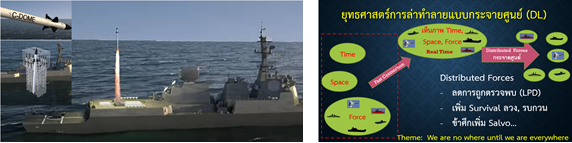
สหรัฐฯ จะใช้แนวคิดการล่าทำลายแบบกระจายศูนย์ (Distributed Lethality: DL ควบคุมทะเลในอินโด-แปซิฟิกหากเกิดวิกฤติขัดแย้ง เพื่อทะลวงแนวป้องกัน Anti Access/ Area/ Denail (A2/AD) และจู่โจมทำลายระบบบูรณาการป้องกันภัยทางอากาศ (Integrated Air Defense System: IADS) ของจีน แนวคิดนี้จึงแพร่หลายเข้าสู่ประเทศเพื่อนบ้านที่มีความขัดแย้งพิพาทในเส้นเขตแดนกับไทย กระทบต่อการรักษาความมั่นคงทางทะเลของกองทัพเรือ ต่อมาสหรัฐฯ ปรับปรุงแนวคิดปฏิบัติการทางทะเลแบบกระจายศูนย์ (Distributed Maritime Operation: DMO) ให้ครอบคลุมปฏิบัติการทุกโดเมนและการรบร่วม ผสมผสานเทคโนโลยีสมัยใหม่แบบ Artificial Intelligence (AI) และเทคโนโลยีอัตโนมัติ ลดบทบาทการพึ่งพาระบบ Network Centrix Warfare (NCW) แต่พึ่งพิงการตัดสินใจรวมศูนย์ (Decision Centrix Warfare: DCW) โดยในระดับกองเรือใช้เครือข่ายแบบ Fleet Centrix ดำรงความเป็นเลิศด้านข้อมูลข่าวสาร (Information Superiority) ในขณะที่จีนใช้ยุทธศาสตร์คล้ายกันแต่ประสิทธิภาพสูงกว่า คือ Informatization โดยบทความนี้ได้บูรณาการแนวคิดของจีนและสหรัฐฯ เข้าด้วยกันเป็นหลักการใหม่คือ “ปฏิบัติการทางทะเลแบบกระจายศูนย์ด้วยความเป็นเลิศด้านข้อมูลข่าวสาร (Informatized Distributed Maritime Operation: IDMO) สำหรับใช้รักษาความมั่นคงทางทะเลที่ครอบคลุมภารกิจและบทบาทกองทัพเรือในอนาคตอย่างครบถ้วน
Downloads
Article Details

อนุญาตภายใต้เงื่อนไข Creative Commons Attribution-NonCommercial-NoDerivatives 4.0 International License.
บทความในวารสารนี้อยู่ภายใต้ลิขสิทธิ์ของ ศูนย์ศึกษายุทธศาสตร์ทหารเรือ กรมยุทธศึกษาทหารเรือ และเผยแพร่ภายใต้สัญญาอนุญาต Creative Commons Attribution-NonCommercial-NoDerivatives 4.0 International (CC BY-NC-ND 4.0)
ท่านสามารถอ่านและใช้งานเพื่อวัตถุประสงค์ทางการศึกษา และทางวิชาการ เช่น การสอน การวิจัย หรือการอ้างอิง โดยต้องให้เครดิตอย่างเหมาะสมแก่ผู้เขียนและวารสาร
ห้ามใช้หรือแก้ไขบทความโดยไม่ได้รับอนุญาต
ข้อความที่ปรากฏในบทความเป็นความคิดเห็นของผู้เขียนเท่านั้น
ผู้เขียนเป็นผู้รับผิดชอบต่อเนื้อหาและความถูกต้องของบทความของตนอย่างเต็มที่
การนำบทความไปเผยแพร่ซ้ำในรูปแบบสาธารณะอื่นใด ต้องได้รับอนุญาตจากวารสาร
เอกสารอ้างอิง
Mengxiong Chang, The Revolution in Military Affair: Weapon of 21st Century, Leonado DRS, Multidomain battle Management, <https://fas.org/nuke/guide/china/doctrine>
Vego N. Milan, Operational Warfare at Sea, Routledge, Milton Park, Abingdon, Oxon, 2009
Australia’s Victorian Government Committee, Cyber Security Strategy’s
US CSBA, Mark Gunzinger, et al, Force Planning for the era of Great Power Competition, 2017.
US CSBA, Clark Bryan, et al, Mosaic Warfare: Exploiting AI and Autonomous Systems to Implement Decision-Centric Operations, 2020.
US CSBA, Clark Bryan et al, Winning the Gray Zone: Using EM Warfare to Regain Escalation Dominance, 2017.
US CSBA, Renberg Carl and Gunzinger Mark, Air and Missile Defense at Crossroad: New Concepts and Technologies to defense America Oversea Bases, 2018
US CSIS, Cordesman Antony H., China New 2019 Defense White Paper, 2019.
US DOD, Military and Strategy Development of the PRC, Annual Report to Congress, Aug 21, 2020
US DOD, Military and Security Developments Involving the PRC, Annual Report to Congress, 2019.
US Defense Intelligence Agency, China Military Power: Modernizing a Force to Fight and Win, 2019.
US DOD JP-05, Oct 2020
US Marine Corp, Force Design 2030, 2020.
US National Security Strategy, December 2017
US Navy ISR Roadmap, Industry Day, 2010.
US Navy, A Design for Maintaining Maritime Superiority, Version 2.0 Dec 2018.
US Navy and US Marine Corps, Littoral Operation in a Contested Environment, 2017.
US NIC, Global Trend 2040, 2021.
Congressional Research Service, Navy Force Structure and Shipbuilding Plans: Background and Issues for Congress, Oct 7, 2020.
Morgan E. Forrest and Cohen S. Raphael, Military Trend and Future of Warfare, RAND, 2020.
Jeffry J.E et al, A Tactical Doctrine for Distributed Lethality, Feb 22, 2016, Dudley Library, Naval Postgraduate School, Monterey, USA
Papa et al, DMO and Unmanned System Tactical Deployment, US Nawal Post Graduate School, 2018.
Alan Coming, “Distributed Lethality: China is doing it Right,” A CIMSEC Compendium, Feb 22, 2016, http://www.cimsec.org/
John Devlin, LCDR, “Refiguring a Cushioned Vehicle to Enhance Distributed Lethality,” A CIMSEC Compendium, Feb 22, 2016.
Kline Jeffrey E., CAPT USN (ret), “A Tactical Doctrine for Distributed Lethality,” Center of Maritime Security, Feb 22, 2016.
O’Connor Chris r, LCDR, “Distributed Leathernecks,” A CIMSEC Compendium, Feb 22, 2016.
Sapaty Simon Peter, “Mosaic Warfare: From Philosophy to Model to Solutions,” Med Crave, International & Automation Journal, Volume 5 Issue 5, 2109.
Uppal Rajesh, “US Navy Operating DMO, Strategy Integrating Diverse Autonomous Unmanned Vehicles UUV, USVs, UAVs”, 2021.
Beeryl Pual T., et al, “Command and Control for Distributed Lethality,” Conference Paper, RearchGate , April, 2019.
CRUSER and Naval Post Graduate School, DMO Warfare Innovation Continuum, 2017.
Diane S. Cua, CDR, USN. Distributed Lethality and a Surface Experimental Test Squadron, Naval War College, New Port, RI, 29 May 2017.
Fox Collin, LCDR, “Implementing Distributed Lethality within the Joint Operation Access Concept,” A CIMSEC Compendium, Feb 22, 2016.
Gerson Michael and Whiteneck Daniel, “Deterrence and Influence: The Navy’s Role in Preventing War (Citing Lawrence Freedman),” 2020.
Gunzinger Mark et al, Force Planning for the Era of Great Power Competition, CSBA, 2017.
Popa Christopher H. et al, DMO and Unmanned Systems Tactical Employment Naval Post Graduate School, 2018.
Richards Scott K., Jr, The Advanced Surface Fleet, A Proposal for an Alternative Surface Force US CSBA, Mahnken G. Thomas, et al, Deterrence by Detection, 2020.
US Navy, Advantage at Sea: Prevailing with Integrated All-Domain Naval Power, 2020.
US CSBA, Mahnken G. Thomas, et al, Forging the Tools of 21st Century Great Power Competition, 2020.
US CSBA, Clark Bryan, The Future of Warfare, 2015.
US Naval Surface Force, Surface Force Strategy, Return to Sea Control, 2016.
US CSBA, Clark Bryan and Timothy A. Walton, Taking Back the Sea, 2019.
