ความสัมพันธ์ระหว่างผลิตภัณฑ์มวลรวมในประเทศกับระดับความสุขของประชาชนในกลุ่มประเทศสมาชิกอาเซียน
Article Sidebar
Main Article Content
บทคัดย่อ
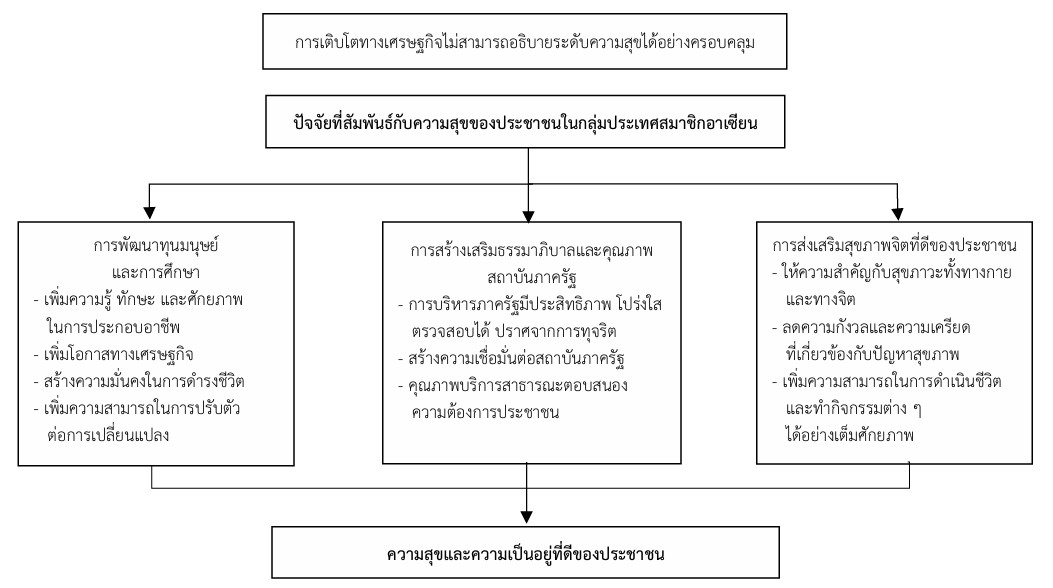
การศึกษานี้มีวัตถุประสงค์เพื่อศึกษาความสัมพันธ์ระหว่างผลิตภัณฑ์มวลรวมในประเทศกับระดับความสุขของประชาชน และศึกษาปัจจัยอื่นที่เกี่ยวข้องกับระดับความสุขของประชาชนในกลุ่มประเทศสมาชิกอาเซียน 7 ประเทศ ได้แก่ ประเทศไทย สิงคโปร์ กัมพูชา ฟิลิปปินส์ อินโดนีเซีย เวียดนาม และมาเลเซีย โดยใช้ข้อมูลทุติยภูมิในรูปแบบข้อมูลพาเนลรายปี ครอบคลุมช่วงปี พ.ศ. 2551–2564 ตัวแปรตามคือดัชนีความสุข ส่วนตัวแปรอิสระประกอบด้วยปัจจัยด้านเศรษฐกิจ สุขภาพ สังคม ธรรมาภิบาล ประสิทธิผลภาครัฐ และโครงสร้างประชากร การวิเคราะห์ข้อมูลใช้แบบจำลองข้อมูลพาเนล โดยผลการทดสอบ Hausman Test สนับสนุนการเลือกใช้แบบจำลอง Random Effects จึงประมาณค่าด้วยวิธีดังกล่าว นอกจากนี้ ยังได้รวมการควบคุมผลกระทบเฉพาะช่วงเวลาและตัวแปรล่าช้าไว้ในการวิเคราะห์ด้วย ผลการศึกษาจากการประมาณค่าโดยใช้ตัวแปรในรูปผลต่างลำดับที่ 1 พบว่า ผลิตภัณฑ์มวลรวมในประเทศต่อหัวไม่มีความสัมพันธ์กับระดับความสุขของประชาชนอย่างมีนัยสำคัญทางสถิติ ขณะที่ดัชนีการศึกษาในช่วงเวลาเดียวกันมีความสัมพันธ์เชิงบวกและมีนัยสำคัญทางสถิติอย่างสม่ำเสมอ สะท้อนให้เห็นว่าการพัฒนาด้านการศึกษามีความเชื่อมโยงกับระดับความสุขของประชาชนที่สูงขึ้น นอกจากนี้ ประสิทธิผลของรัฐบาลมีความสัมพันธ์เชิงบวกกับระดับความสุข ส่วนอัตราการเสียชีวิตจากฆ่าตัวตายและดัชนีการรับรู้การทุจริตมีความสัมพันธ์เชิงลบกับระดับความสุข ขณะที่ค่าล่าช้าของดัชนีการรับรู้การทุจริตมีความสัมพันธ์เชิงบวก สะท้อนว่าผลของการลดการทุจริตอาจต้องใช้ระยะเวลาจึงจะส่งผลต่อระดับความสุขของประชาชน ผลการวิจัยชี้ให้เห็นว่า การส่งเสริมความสุขของประชาชนไม่ควรมุ่งเน้นเพียงการเติบโตทางเศรษฐกิจเท่านั้น แต่ควรให้ความสำคัญกับการพัฒนาการศึกษา สุขภาพ และธรรมาภิบาลภาครัฐควบคู่กัน เพื่อยกระดับคุณภาพชีวิตและความเป็นอยู่ที่ดีของประชาชนอย่างยั่งยืน
Article Details

อนุญาตภายใต้เงื่อนไข Creative Commons Attribution-NonCommercial-NoDerivatives 4.0 International License.
เอกสารอ้างอิง
กัมลาศ เยาวะนิจ. (2565). องค์ประกอบของผลิตภัณฑ์มวลรวมภายในประเทศและประสิทธิผลของรัฐบาลที่มีอิทธิพลต่อความสุขมวลรวมประชาชาติ. วารสารวไลยอลงกรณ์ปริทัศน์, 12(2), 151–161.
ธนาคารแห่งประเทศไทย. (2563). เศรษฐศาสตร์เล่มเดียวอยู่ ฉบับปรับปรุง. สืบค้นจาก https://www.bot.or.th/th/research-and-publications/articles-and-publications/economics-book.html.
Aribe Jr, S. G., & Panes, J. M. M. (2019). Will State of Happiness Assure Global Peace?. Asia Pacific Journal of Social and Behavioral Sciences, 16, 87-98.
Choi, M., Sempungu, J. K., Kim, M. H., Han, J., & Lee, Y. H. (2024). Happiness and its association with suicide ideation and attempt in Korea: The roles of socio-environmental, psychological, and health-related factors. Journal of Korean Medical Science, 39(44), e283.
Cohen, J. (1988). Statistical power analysis for the behavioral sciences. (2nd ed.). Hillsdale, NJ: Lawrence Erlbaum Associates.
Degutis, M., Urbonavičius, S., & Gaižutis, A. (2010). Relation between life satisfaction and GDP in the European Union. Ekonomika, 89(1), 9–21.
Di Tella, R., MacCulloch, R. J., & Oswald, A. J. (2001). Preferences over inflation and unemployment: Evidence from surveys of happiness. American Economic Review, 91(1), 335–341.
Easterlin, R. A. (1974). Does economic growth improve the human lot? Some empirical evidence. In P. A. David & M. W. Reder (Eds.), Nations and households in economic growth: Essays in honor of Moses Abramovitz (pp. 89–125). New York: Academic Press.
Easterlin, R. A., McVey, L. A., Switek, M., Sawangfa, O., & Zweig, J. S. (2010). The happiness–income paradox revisited. Proceedings of the National Academy of Sciences, 107(52), 22463-22468.
Fadillah, M. I. (2025). Inflation, income, and happiness: Contrasting low-income developing countries and advanced economies. American Journal of Economic and Management Business, 4(1), 106–114.
Giansyah, R. W., Sambodo, H., Binardjo, G., & Suharno, S. (2024). Happiness index in ASEAN-9 2015–2021: Macroeconomic and demographic perspectives. Economics Development Analysis Journal, 12(4), 537–547.
Global Data Lab. (2021). Educational index. Retrieved from https://globaldatalab.org/shdi/.
Hausman, J. A. (1978). Specification tests in econometrics. Econometrica, 46(6), 1251–1271.
Hsu, C. Y., Chang, S. S., & Yip, P. S. F. (2019). Subjective wellbeing, suicide and socioeconomic factors: an ecological analysis in Hong Kong. Epidemiology and psychiatric sciences, 28(1), 112-130.
Hudomiet, P., Hurd, M. D., & Rohwedder, S. (2021). The age profile of life satisfaction after age 65 in the US. Journal of Economic Behavior & Organization, 189, 431-442.
Im, K. S., Pesaran, M. H., & Shin, Y. (2003). Testing for unit roots in heterogeneous panels. Journal of econometrics, 115(1), 53-74.
Institute for Economics and Peace. (2021). Global Peace Index. Retrieved from https://www.visionofhumanity.org/maps/.
International Labour Organization. (2021). ILOSTAT database. Retrieved from https://ilostat.ilo.org/data/.
Lous, B., & Graafland, J. (2022). Who becomes unhappy when income inequality increases?. Applied Research in Quality of Life, 17(1), 299–316.
Ma, J., Guo, B., & Yu, Y. (2022). Perception of official corruption, satisfaction with government performance, and subjective wellbeing-An empirical study from China. Frontiers in Psychology, 13, 748704.
Mathentamo, Q., Lawana, N., & Hlafa, B. (2024). Interrelationship between subjective wellbeing and health. BMC Public Health, 24(1), 2213.
Powdthavee, N., Burkhauser, R. V., & De Neve, J. E. (2017). Top incomes and human well-being: Evidence from the Gallup World Poll. Journal of Economic Psychology, 62, 246-257.
Proto, E., & Rustichini, A. (2013). A reassessment of the relationship between GDP and life satisfaction. PloS one, 8(11), e79358.
Stevenson, B., & Wolfers, J. (2008). Economic growth and subjective well-being: Reassessing the Easterlin paradox (NBER Working Paper No. 14282). Cambridge, MA: National Bureau of Economic Research.
Stryzhak, O. (2020). The relationship between education, income, economic freedom and happiness. SHS Web of Conferences, 75, 03004.
Transparency International. (2021). Corruption Perceptions Index. Retrieved from https://www.transparency.org/en/cpi/2021.
Wells, T. (n.d.). Sen’s capability approach. Internet Encyclopedia of Philosophy. Retrieved from https://iep.utm.edu/sen-cap/.
World Bank. (2021). Worldwide Governance Indicators. Retrieved from https://www.worldbank.org/en/publication/worldwide-governance-indicators.
World Happiness Report. (2021). World Happiness Report data. Retrieved from https://data.worldhappiness.report/map.
World Health Organization. (2021). WHO data: Indicators. Retrieved from https://data.who.int/indicators.
World Inequality Database. (2021). World Inequality Database. Retrieved from https://wid.world/data/.
Yang, Y., Zhao, L., & Cui, F. (2022). How does public health investment affect subjective well-being? Empirical evidence from China. International Journal of Environmental Research and Public Health, 19(9), 5035.