Efficiency of Government Emergency Management for Typhoon Disasters in Zhoushan City, Zhejiang Province, People’s Republic of China
Article Sidebar
Main Article Content
บทคัดย่อ
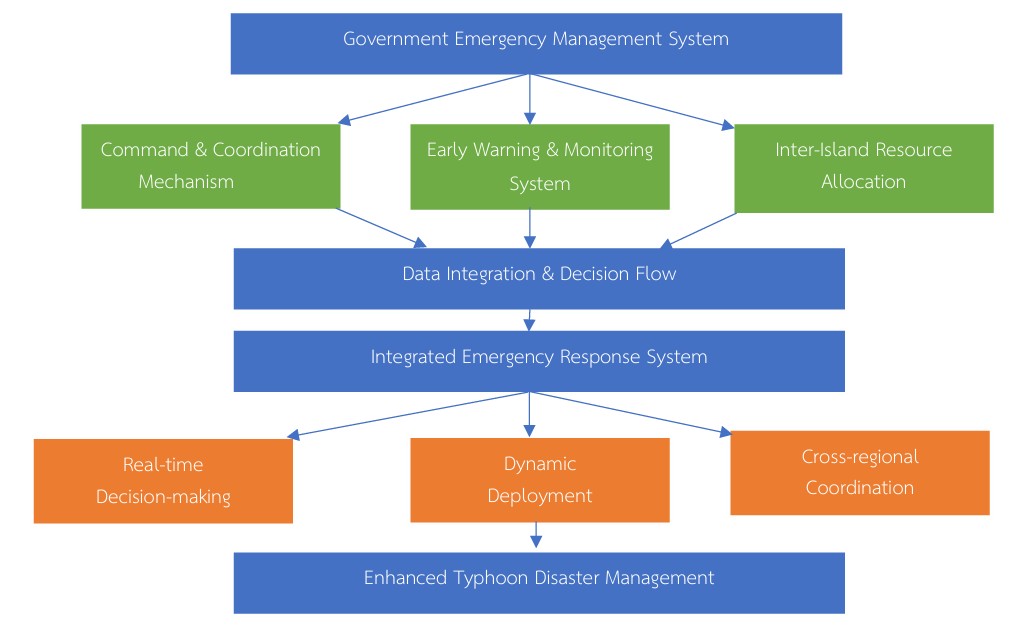
This article aimed 1) To analyze the strengths and limitations of current governmental emergency management mechanisms in responding to typhoon disasters in Zhoushan; 2) to assess the effectiveness of early warning systems and emergency resource allocation in typhoon disaster management in Zhoushan; and 3) to examine the operational challenges of inter-island and maritime emergency response during typhoon disasters in Zhoushan. The research was a qualitative approach. This research procedures were divided into three steps: Identifying the key variables related to emergency management performance, early warning systems, and resource allocation efficiency; examining the components of government coordination, public satisfaction, and system integration; and formulating strategic guidelines and policy recommendations to optimize emergency management practices in coastal cities such as Zhoushan. Data collection was conducted through in-depth interviews with 24 respondents, consisted 12 men and 12 women, aged 30-50 years old, all of whom were participants in the emergency management of typhoon disasters. The result of this research found that: 1) the current government emergency management mechanism in Zhoushan City had unique advantages in responding to typhoon disasters, but also had obvious limitations; 2) the clarified of the effective ways for government agencies to establish inter island warning systems and allocated emergency resources; and 3) the inter-island warning system and emergency resource allocation method established by government agencies could efficiently respond to typhoon disasters.
Article Details

อนุญาตภายใต้เงื่อนไข Creative Commons Attribution-NonCommercial-NoDerivatives 4.0 International License.
เอกสารอ้างอิง
Chang, S. E., & Falit-Baiamonte, A. (2002). Disaster vulnerability of businesses in the 2001 Nisqually earthquake. Global Environmental Change Part B: Environmental Hazards, 4(2), 59-71.
Elsner, J., & Jagger, T. (2023). Hurricane Climatology: A Modern Statistical Guide Using R. Oxford: Oxford University Press.
Fan, H. (2025). Effectively Integrating UAVs into the Wildfire Emergency Management System in China: Case Study of Sichuan Province. (Master Thesis, Westfälische Wilhelms-Universität).
Goodchild, M. F., & Glennon, J. A. (2010). Crowdsourcing geographic information for disaster response: a research frontier. International Journal of Digital Earth, 3(3), 231-241.
Hallegatte, S., Rentschler, J., & Rozenberg, J. (2019). Lifelines: The Resilient Infrastructure Opportunity. Washington, D.C.: World Bank Publications.
Huang, Y., Xu, C., He, X., Gao, H., Wang, W., & Yi, Y. (2025). Trends and Evolution in the Study of China's Natural Disaster Emergency Plans: A Bibliometric Analysis. Evidence in Earth Science, 1(01), 33-51.
Key Informant 1. (2025). Director of the Flood Control and Drought Relief Department at Zhoushan Emergency Management Bureau. Interview. November 9.
Key Informant 13. (2025). Member of the “Three Defense” Command in Dongji Town. Interview. November 3.
Key Informant 19. (2025). Villager from Wushitang Village, Zhujiajian Island, Zhoushan City. Interview. December 13.
Key Informant 21. (2025). President of Huangxing Village Fishery Cooperative. Interview. December 7.
Key Informant 23. (2025). Grid Chief of Xida Community. Interview. December 5.
Key Informant 4. (2025). Captain of Zhoushan Qian Island Rescue Team. Interview. November 17.
Key Informant 6. (2025). Search and Rescue Coordinator at Zhoushan Maritime Safety Administration. Interview. November 15.
Key Informant 7. (2025). Senior Engineer at Zhoushan Marine Environmental Monitoring and Forecasting Center. Interview. November 11.
Kongthon, A., Haruechaiyasak, C., Pailai, J., & Kongyoung, S. (2014). The role of social media during a natural disaster: A case study of the 2011 Thai Flood. International Journal of Innovation and Technology Management, 11(03), 1440012.
Pal, A., Wang, J., Wu, Y., Kant, K., Liu, Z., & Sato, K. (2022). Social media driven big data analysis for disaster situation awareness: A tutorial. IEEE Transactions on Big Data, 9(1), 1-21.
Pelling, M., & Uitto, J. (2001). Small island developing states: natural disaster vulnerability and global change. Global Environmental Change Part B: Environmental Hazards, 3(2), 49-62.
Shi, P. (2019). Hazards, disasters, and risks. In Disaster risk science (pp. 1-48). Singapore: Springer Singapore.
Sun, H., Zhang, X., Ruan, X., Jiang, H., & Shou, W. (2024). Mapping compound flooding risks for urban resilience in coastal zones: A comprehensive methodological review. Remote Sensing, 16(2), 350.
Suvanachai, P., Kawbunjun, A., Kittiwanich, J., Wutticharoenmongkol, N., Poolsawat, N., Somwadee, N., Pophan, W., Jamying, P., Hornak, K., Yoakarakun, C., Chucherd, A., & Intarasab, A., Panchapornudomlap, M. (2025, June). Early warning system prototype development to mitigate coastal aquaculture activities from the climate variability using internet of things (IoT) and artificial intelligence (AI) technologies in Thailand. In 2025 IEEE/ACIS 29th International Conference on Software Engineering, Artificial Intelligence, Networking and Parallel/Distributed Computing (SNPD) (pp. 424-430). Busan, Korea: IEEE.
Talley, W. K., Jin, D., & Kite-Powell, H. (2008). Determinants of the severity of cruise vessel accidents. Transportation research part D: transport and environment, 13(2), 86-94.
Tierney, K. (2014). The social roots of risk: Producing disasters, promoting resilience. Redwood City, California: Stanford University Press.
Wang, X. (2023). Collaborating in a centralized governance mechanism: structure and fragmentation of large-scale response coordination during the 2018 Typhoon Mangkhut in Shenzhen. International Journal of Emergency Services, 12(2), 213-230.
Wuthisuthimethawee, P., Satthaphong, S., Phongphuttha, W., Sarathep, P., Piyasuwankul, T., Công, S. N., Đúc, C. N., Nhu’, L. N., Văn, N. H., Feliciano, J. P., Danac, A. C., Ariani, M., Donna, B., Isturini, I. A., Saelim, P., Pintatham, K., Thepmanee, D., Silapunt, P., Limpaporn, S., Yuddhasaraprasiddhi, K., Promkhum, D., & Ikeda, S. (2022). How the ARCH project could contribute to strengthening ASEAN regional capacities on disaster health management (DHM). Prehospital and disaster medicine, 37(S1), s30-s43.
Yu, J., Liu, J., Baek, J. W., Fong, C., & Fu, M. (2022). Impact-based forecasting for improving the capacity of typhoon-related disaster risk reduction in typhoon committee region. Tropical Cyclone Research and Review, 11(3), 163-173.
Zhang, G., Mao, J., Hua, W., Wu, X., Sun, R., Yan, Z., Liu, Y., & Wu, G. (2023). Synergistic effect of the planetary-scale disturbance, typhoon and meso-β-scale convective vortex on the extremely intense rainstorm on 20 July 2021 in Zhengzhou. Advances in Atmospheric Sciences, 40(3), 428-446.
Zhou, G., Fang, X., Qian, Q., Lv, X., Cao, J., & Jiang, Y. (2022). Application of artificial intelligence technology in typhoon monitoring and forecasting. Frontiers in Earth Science, 10, 974497.
Zhou, N., Liu, Y., Tong, H., Li, Y., & Wu, Q. (2025). Natural Disaster Emergency Management in China Based on Quantitative Content Analysis of Central Government Policy Tools. Sustainability, 17(13), 6106.
