Challenges in Enhancing Government Decision-Making Ability in the Big Data Era
Article Sidebar
Main Article Content
บทคัดย่อ
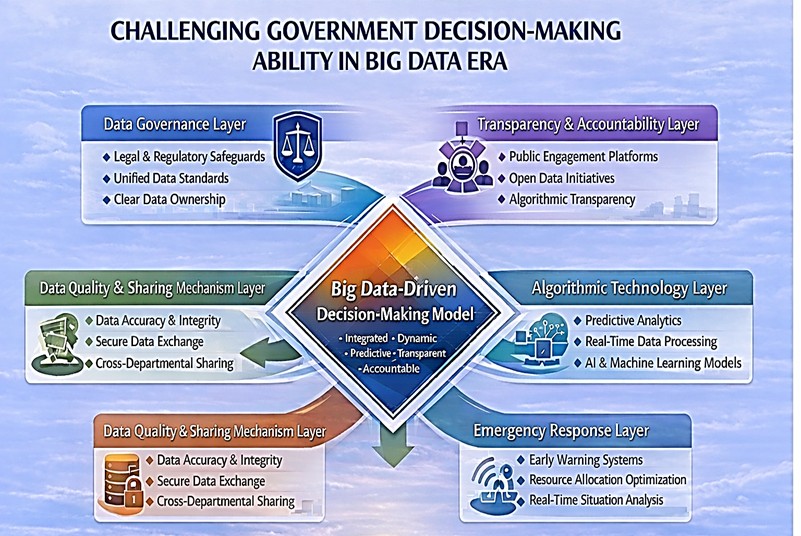
This article aimed to study: 1) the impact of big data on government decision-making processes; 2) case studies of successful big data applications in government decision-making; and 3) the key challenges and limitations that governments face when integrating big data into decision-making frameworks. The research methodology was qualitative, examining the challenges of government decision-making ability in the big data era. The key informants consisted of 20 policymakers, data analysts, IT experts, and administrative officials in Beijing, Shanghai, Zhengzhou, Zhumadian, and Hebi City, Henan Province, selected through purposive sampling. Data were collected using interviews, observations, and document analysis, and the data were analyzed using descriptive analysis. The results of the research study found that: 1) in analyzing the impact of big data on government decision-making processes, big data enhanced the efficiency and evidence-based quality of decision-making; 2) in exploring case studies of successful big data applications in government decision-making, it was found that successful applications relied on integrated platforms and cross-departmental data collaboration; and 3) in identifying the key challenges and limitations that governments faced when integrating big data into decision-making frameworks, it was found that data quality, institutional fragmentation, legal restrictions, and privacy issues remained the main challenges. In response, the study proposed an optimization framework that integrates technological, institutional, legal, and public participation dimensions to strengthen effective data-driven decision-making in the public sector.
Article Details

อนุญาตภายใต้เงื่อนไข Creative Commons Attribution-NonCommercial-NoDerivatives 4.0 International License.
เอกสารอ้างอิง
Binns, R., Van Kleek, M., Veale, M., Lyngs, U., Zhao, J., & Shadbolt, N. (2018, April). 'It's Reducing a Human Being to a Percentage' Perceptions of Justice in Algorithmic Decisions. In Proceedings of the 2018 Chi conference on human factors in computing systems (pp. 1-14). Montréal, QC, Canada: Association for Computing Machinery.
Chatterjee, H. A. (2021). Big Data Analytics in E-Governance: Insights for Policy Formulation and Public Service Delivery. International Journal of Research Publications in Engineering, Technology and Management, 4(1), 4337-4339.
Chen, L., & Zeng, S. (2021). The relationship between intolerance of uncertainty and employment anxiety of graduates during COVID-19: The moderating role of career planning. Frontiers in Psychology, 12, 694785.
Chen, Y. C., & Hsieh, T. C. (2014). Big data for digital government: Opportunities, challenges, and strategies. International journal of public administration in the digital age, 1(1), 1-14.
Fredriksson, C., Mubarak, F., Tuohimaa, M., & Zhan, M. (2017). Big data in the public sector: A systematic literature review. Scandinavian Journal of Public Administration, 21(3), 39-61.
Hashem, A., Abd_Allah, E. F., Alqarawi, A. A., Al-Huqail, A. A., Wirth, S., & Egamberdieva, D. (2016). The interaction between arbuscular mycorrhizal fungi and endophytic bacteria enhances plant growth of Acacia gerrardii under salt stress. Frontiers in microbiology, 7, 1089.
Hochstetter-Diez, J., Negrier-Seguel, M., Diéguez-Rebolledo, M., Vásquez-Morales, F., & Sancho-Chavarría, L. (2023). Governance Democratic and Big Data: A Systematic Mapping Review. Sustainability, 15(16), 12630.
Hossin, M. A., Du, J., Mu, L., & Asante, I. O. (2023). Big data-driven public policy decisions: Transformation toward smart governance. Sage Open, 13(4), 21582440231215123.
Janssen, M., & Kuk, G. (2016). The challenges and limits of big data algorithms in technocratic governance. Government Information Quarterly, 33(3), 371-377.
Key Informant 1. (2025). Vice President and Chief Engineer. Interview. 12 December.
Key Informant 12. (2025). Digital Media Expert, Professor. Interview. 20 December.
Key Informant 18. (2025). Associate Professor, Data Governance Expert. Interview. 25 December.
Key Informant 2. (2025). Chief Data Officer. Interview. 18 December.
Key Informant 4. (2025). Chief Data Officer and Chief Engineer. Interview. 14 December.
Key Informant 6. (2025). Deputy Director and Senior Engineer. Interview. 22 December.
Lan, X., Pang, X., Tan, K., Hu, M., Zhu, X., Li, D., & Wang, Y. (2025). Reproductive effects of phthalates and microplastics on marine mussels based on adverse outcome pathway. Environmental Science & Technology, 59(16), 7835-7844.
Matheus, R., Janssen, M., & Maheshwari, D. (2020). Data science empowering the public: Data-driven dashboards for transparent and accountable decision-making in smart cities. Government Information Quarterly, 37(3), 101284.
Meijer, A. (2018). Datapolis: A public governance perspective on “smart cities”. Perspectives on public management and governance, 1(3), 195-206.
Meijer, A., & Wessels, M. (2019). Predictive policing: Review of benefits and drawbacks. International journal of public administration, 42(12), 1031-1039.
Russo, S., Sillmann, J., & Fischer, E. M. (2015). Top ten European heatwaves since 1950 and their occurrence in the coming decades. Environmental Research Letters, 10(12), 124003.
Zuiderwijk, A., & Janssen, M. (2014). Open data policies, their implementation and impact: A framework for comparison. Government information quarterly, 31(1), 17-29.
